Bank Asking for a W-9? What a Foreign-Owned US LLC Should Send (W-9, W-8BEN or W-8BEN-E)
Your bank or platform asks your US LLC for a W-9, but you own it from abroad. What the IRS instructions say about W-9 vs W-8BEN vs W-8BEN-E, the name and EIN traps, and what happens when a payer has no form.
 Written by Amel Ouchene, IRS PTIN holderLast updated Not legal or tax advice11 min read
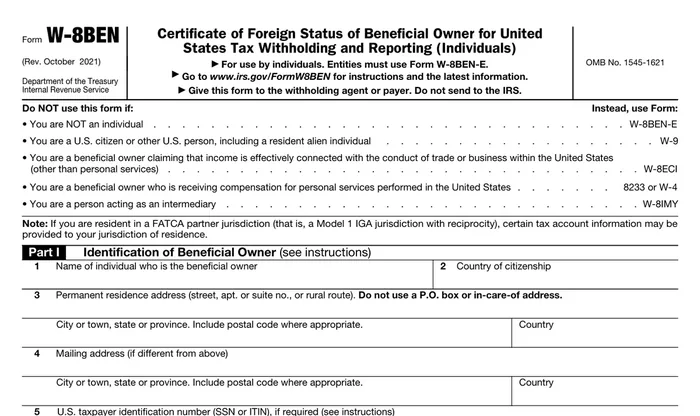
A bank, a payment platform or a US client asks your US LLC for "a W-9". The request is natural: the LLC is American. But the IRS instructions say that when the LLC is a single-member entity owned by a foreign person, the owner completes a Form W-8 instead of a Form W-9. Which form is right depends on how the LLC is classified and who owns it.
In short:
- Single-member LLC owned by a foreign person: the Form W-9 instructions say "the owner must complete an appropriate Form W-8 instead of a Form W-9. This is the case even if the foreign person has a U.S. TIN." A foreign individual owner uses Form W-8BEN; a foreign company owner uses Form W-8BEN-E.
- LLC with several owners, or taxed as a corporation: it is a U.S. person for these forms and gives a Form W-9 with its own EIN.
- Name trap: on a W-9 for a disregarded entity, line 1 is the owner's name, not the LLC's. On a W-8BEN, the LLC's name goes in the reference-number box, not in the name box.
- Why payers insist: without valid documentation, a payer making U.S.-source payments to a foreign person may have to withhold 30% and is itself liable if it does not.
Why a bank or platform asks an LLC for a W-9
The W-9 is the IRS form a payer uses to collect a payee's name and taxpayer identification number (TIN) and to confirm the payee is a U.S. person. A payer that sees a US LLC with an EIN often sends the W-9 by default. The IRS instructions for the form say a foreign person must not use it: "If you are a foreign person ... do not use Form W-9. Instead, use the appropriate Form W-8 or Form 8233."
So a W-9 request does not tell you which form is correct. It tells you that the payer wants tax documentation. The right answer comes from your structure.
Which form: the IRS rules in a table
| Your LLC | Who gives the form | Form | What the IRS instructions say |
|---|---|---|---|
| One owner, a foreign individual, default classification | The owner | W-8BEN | W-9 instructions, line 1: "If the owner of the disregarded entity is a foreign person, the owner must complete an appropriate Form W-8 instead of a Form W-9." |
| One owner, a foreign company | The owner (the company) | W-8BEN-E | W-8BEN-E instructions: the single owner "if such owner is a foreign person, should provide Form W-8BEN or Form W-8BEN-E (as appropriate)". |
| One owner, a U.S. person | The owner | W-9 | W-9 instructions: in the case of a disregarded entity with a U.S. owner, "the U.S. owner of the disregarded entity and not the disregarded entity" provides it. |
| Two or more owners (partnership) | The LLC | W-9 (if all conditions of a U.S. entity are met) | A partnership "created or organized in the United States" is a U.S. person. Multi-owner LLCs raise other filings: see Form 1065 or 5472 for a multi-member LLC. |
| LLC that elected corporation status (Form 8832 or 2553) | The LLC | W-9 | The W-9 line 3a instructions list an LLC "that has filed Form 8832 or 2553 electing to be taxed as a corporation" and ask for the C or S code. |
| Income effectively connected with a U.S. trade or business | The foreign owner | W-8ECI | See effectively connected income and the W-8BEN-E guide. |
A single-member LLC is a disregarded entity by default: the IRS looks through it to its owner. If you are not sure whether your LLC kept the default, check whether anyone filed Form 8832 for it. We do not give advice on the tax law of your country of residence.
To test your own case quickly, use the W-8 or W-9 form finder.
The name trap: owner or LLC?
Most rejected forms come from the name line.
- W-9, disregarded entity with a U.S. owner. The W-9 says to enter "the owner's name on line 1" and the disregarded entity's name on line 2. The name on line 1 "should never be a disregarded entity". Line 3a takes the tax classification of the owner.
- W-9, LLC that is not disregarded. The W-9 says to enter the entity's name as shown on its tax return on line 1 and any business name on line 2. On line 3a you check "LLC" and enter C, S or P.
- W-8BEN, foreign individual who owns a disregarded LLC. The W-8BEN instructions say to complete the form "with your name and information". If the payment account is in the LLC's name, you tell the payer by "including the name and account number of the disregarded entity on line 7 (reference number)".
- W-8BEN-E, foreign company owner. The line 1 instructions say a disregarded entity should not enter its business name: "Instead, enter the legal name of your owner".
Line 3b, "foreign partners": is it for you?
Line 3b of the W-9 is easy to misread as "do you have a foreign owner?" It is narrower. The form says to check it if you are a partnership (including an LLC classified as a partnership), trust or estate with foreign partners, owners or beneficiaries, and you are providing the form to a partnership, trust or estate in which you have an ownership interest. A bank account opening is not that situation, so do not tick it just to signal a foreign owner. If in doubt, read the line 3b instructions before you sign.
The EIN question
- W-9, LLC not disregarded. Part I asks for the entity's EIN: "If the LLC is classified as a corporation or partnership, enter the entity's EIN."
- W-9, disregarded LLC with a U.S. owner. The owner's SSN, or EIN if the owner has one.
- W-8BEN. Line 5 takes an SSN or ITIN; line 6a takes a foreign tax identifying number. The instructions say that if you claim certain treaty benefits you must complete line 5 with an SSN or ITIN, or line 6 with a foreign TIN. A U.S. TIN is not a general condition for every W-8BEN.
If a payer says your name and EIN do not match, the usual proof is an IRS letter confirming the EIN. See Letter 147C and, if you do not have an EIN yet, getting an EIN without an SSN.
What to avoid
- Signing a W-9 to get through the screen. The W-9 certification says "I am a U.S. citizen or other U.S. person" and is signed under penalties of perjury. If you are a foreign person, that is a false statement.
- Putting the LLC's name where the owner's goes (or the reverse), as above.
- Sending the form to the IRS. W-8 forms go to the person who asks for them, not to the IRS.
- Letting a W-8BEN lapse. The form is generally valid until the last day of the third succeeding calendar year after signing, unless circumstances change. See the W-8BEN-E guide for the rule and the 30-day notice.
If an onboarding screen only offers a W-9 for a foreign-owned LLC, look for a "not a US person" option, or write to support quoting the W-9 instruction above.
W-8BEN and W-8BEN-E in one minute (and "W9 BEN")
"W9 BEN" usually means comparing the W-9 with the W-8BEN. The W-9 certifies a U.S. person; the W-8BEN is for a foreign individual; the W-8BEN-E is for an entity. The W-8BEN-E form reads "For use by entities. Individuals must use Form W-8BEN." For a line-by-line walk-through, see the W-8BEN guide and the W-8BEN-E guide.
The payer's side: what if a foreign contractor gives no W-8BEN?
Your LLC may also be the one asking. If you pay a contractor outside the US, you are the payer, and Publication 515 (2026) is written for you.
- No documentation, possible 30%. For chapter 3, "in most cases, you must withhold 30% from the gross amount paid to a foreign payee unless you can reliably associate the payment with valid documentation". The Form W-8BEN instructions say it to the payee: if you do not provide the form, "the withholding agent may have to withhold at the 30% rate".
- The payer is liable. "As a withholding agent, you are personally liable for any tax required to be withheld. ... If you fail to withhold and the foreign payee fails to satisfy its U.S. tax liability, then both you and the foreign person are liable for tax, as well as interest and any applicable penalties." If the foreign person pays the tax, the payer "remains liable for any interest and penalties for failure to withhold."
- Get the form before you pay. The Publication says you "must get the documentation before you make the payment" and, if you cannot rely on documentation, you must apply the presumption rules.
- Withholding applies to U.S.-source income. For personal services, "the place where the services are performed determines the source of the income". The Publication ties U.S.-source treatment of personal services to where they are performed in the United States. Whether and how much to withhold in your case depends on the facts (the text we checked does not address services performed entirely abroad outright), so settle it before you pay and collect the form anyway.
- Payees who are U.S. persons. For US contractors, ask for a W-9. The requester instructions say a payor must withhold 24% (backup withholding) when a payee fails to furnish a TIN, until the cause is remedied.
- Reporting. The IRS says nonemployee compensation paid to nonresident aliens is reported on Form 1042-S, not Form 1099-NEC; whether tax is withheld depends on the payee and on where the services are performed. Our guide Form 1099-NEC for a foreign-owned US LLC covers the four tests, the $2,000 threshold from 2026 and the February 1, 2027 deadline.
The IRS text we checked has no fixed "penalty for not getting a W-8BEN": the consequence is the withholding duty and the payer's liability for tax, interest and penalties.
What Melya can do
- W-8BEN or W-8BEN-E Preparation, $69. We prepare the form that matches your structure for your signature.
- Banking & Payments Compliance, $149. W-8BEN or W-8BEN-E preparation plus a foreign qualification check, when a bank or processor is asking for tax forms.
- Platform Tax Setup, $79. The correct W-8 and matching names in the tax settings of Stripe, Amazon, PayPal or Upwork.
- Form 1099-NEC (Assessment), $95, if your LLC pays contractors.
Melya is a tax preparation business whose founder holds a PTIN. We do not represent you before the IRS or before your bank.
Related guides
- Bank account for a US LLC with a non-resident owner
- W-8 or W-9 form finder
- Form W-8BEN-E for a US LLC owner
- Form W-8BEN line by line
- what a foreign-owned US LLC files each year
- Letter 147C to prove your EIN
- US-France tax treaty for a foreign-owned US LLC
- US-Switzerland tax treaty for a foreign-owned US LLC
Frequently asked questions
My bank asks my foreign-owned LLC for a W-9. Do I send it?
Not automatically. For a single-member LLC with a foreign owner, the W-9 instructions say the owner completes a Form W-8 instead. If your LLC has several owners or elected corporation status, it gives a W-9 under its own EIN.
What is the difference between a W-8BEN and a W-8BEN-E?
The W-8BEN is for individuals and the W-8BEN-E is for entities. The W-8BEN-E says "Individuals must use Form W-8BEN."
What name goes on the form if the account is in the LLC's name?
On a W-8BEN, your own name goes in the name line, and you can show the LLC's name and account number in the reference-number line. On a W-9 for a disregarded entity, the owner's name is line 1 and the LLC's name is line 2.
Does my LLC need an EIN to complete these forms?
A W-9 for an LLC that is not disregarded asks for its EIN. A W-8BEN asks for an SSN, ITIN or foreign tax identifying number depending on the case. Check the form's line instructions.
I pay a contractor abroad and have no W-8BEN. What is the risk?
Publication 515 says the payer must withhold 30% on U.S.-source payments to a foreign person unless valid documentation supports a different treatment, and that a payer who fails to withhold is personally liable for the tax, interest and penalties. Where the services are performed matters for the source of the income, so check the facts before you pay.
Does a W-8BEN go to the IRS?
No. The form says to give it to the person who requested it.
Sources
- IRS, Form W-9 and instructions (Rev. March 2024): lines 1, 2, 3a, 3b, Part I, "Foreign person".
- IRS, Instructions for the Requester of Form W-9: backup withholding, foreign persons.
- IRS, Instructions for Form W-8BEN (Rev. October 2021): line 1, line 5, 6a, 7, 30% withholding.
- IRS, Instructions for Form W-8BEN-E (Rev. October 2021): disregarded entities, line 1.
- IRS, Publication 515 (2026), Withholding of Tax on Nonresident Aliens and Foreign Entities: documentation, liability, presumption rules, source of personal service income.
- IRS, Instructions for Forms 1099-MISC and 1099-NEC: Form 1042-S for nonresident aliens.
This page applies the IRS instructions. It is not legal or tax advice and does not cover the tax law of the owner's country.
If the bank also asks for proof the LLC exists, see certificate of good standing and apostille.
Keep reading
Bank, Stripe or Amazon Blocking Your US LLC? Which Document They Mean and How to Get It
Your bank, Stripe or Amazon asks for an EIN letter, a W-9, a W-8BEN or a good standing certificate. What each request means for a US LLC owned from abroad, where to get it, and what Melya prepares.
Read the guideW-8 Forms: Which One Do You Need? W-8BEN, W-8BEN-E, W-8ECI, W-8EXP, W-8IMY
What a W-8 form is, the five forms in the family and who signs each one, how long a W-8 stays valid, what the owner of a US LLC gives, and what happens when a US payer pays a foreign contractor without a W-8BEN.
Read the guideForm W-8BEN and W-8BEN-E for Switzerland: Swiss Residents and Swiss Companies
Which W-8 a Swiss resident or a Swiss company gives a US payer, the Swiss tax number to enter, how to claim the US-Switzerland treaty (0% on interest and royalties, 15% or 5% on dividends), and the case of a US LLC owned from Switzerland.
Read the guideThis article is general information about US tax rules for foreign-owned LLCs, not advice for your specific situation. Rules change; check the date above and ask before you file.