Form W-8BEN-E for a US LLC Owner: Who Must Use It and How to Fill It In
Does your US LLC give a W-8BEN-E? Usually not: its foreign owner does. W-8BEN, W-8BEN-E, W-8ECI or W-9, the main parts of the form, active or passive NFFE, how long it stays valid, and what to do when a platform insists on a W-9.
 Amel Ouchene, US tax preparer (IRS PTIN holder). October 25, 2026, 13 min read
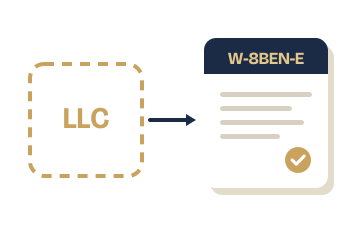
A US platform, bank or client asks your US LLC for "a W-8BEN-E" or "a W-9". Both requests can be wrong. If your LLC has one foreign owner, the IRS instructions say the LLC generally does not sign a W-8BEN-E at all. Its owner does.
In short:
- A single-member US LLC owned from abroad is a disregarded entity, unless it elected to be taxed as a corporation. Per the instructions, it generally does not give a W-8BEN-E itself. Its foreign owner gives the right form.
- Owner is an individual: Form W-8BEN. Owner is a foreign company: Form W-8BEN-E. Effectively connected income (not if you claim treaty benefits, and not if it is allocable to you through a partnership): Form W-8ECI. US person: Form W-9.
- Give the form to the payer, never to the IRS. The form says so at the top.
- A W-8BEN-E is valid until the last day of the third calendar year after you sign it, unless a change in circumstances makes it incorrect. You must notify the payer within 30 days of such a change, and by signing you agree to submit a new form within 30 days.
- Chapter 4 status (line 5) is only required in some cases. A holding company that is not a financial institution may be an active or passive NFFE, depending on its passive income and assets.
Who this guide is for
This page is for owners of a US single-member LLC. If a foreign holding company owns it, the holding company completes the W-8BEN-E. If you own it as a foreign individual, a platform probably used the wrong word: you need a W-8BEN, and this page shows why.
Melya applies the IRS instructions to your structure. We do not give advice on the tax law of the owner's country.
The key trap: the LLC does not sign
A US LLC with one owner is, by default, a disregarded entity. The IRS looks through it to its owner. The Instructions for Form W-8BEN-E (Rev. October 2021) say so in three places.
In the Definitions section, under "Disregarded entity":
"Generally, a disregarded entity does not submit this Form W-8BEN-E to a withholding agent. Instead, the owner of such entity provides the appropriate documentation (for example, a Form W-8BEN-E if the owner is a foreign entity)."
In "Who Must Provide Form W-8BEN-E", under "Do not use Form W-8BEN-E":
"If you are a disregarded entity with a single owner or branch of an FFI, the single owner, if such owner is a foreign person, should provide Form W-8BEN or Form W-8BEN-E (as appropriate). If the single owner is a U.S. person, a Form W-9 should be provided."
In the Specific Instructions for Part I, Line 1:
"If you are a disregarded entity or branch, do not enter your business name. Instead, enter the legal name of your owner (or, if you are a branch, the entity that you form a part of) (looking through multiple disregarded entities if applicable)."
The Form W-9 instructions (Specific Instructions, Line 1) agree:
"If the owner of the disregarded entity is a foreign person, the owner must complete an appropriate Form W-8 instead of a Form W-9. This is the case even if the foreign person has a U.S. TIN."
So the answer to "does my LLC give a W-8BEN-E?" is: generally no. The owner gives a W-8, and the LLC's name is at most a reference. The instructions allow a disregarded entity to use the form itself only in narrow cases: solely to document its own chapter 4 status because it holds an account with an FFI, or as a hybrid entity claiming treaty benefits. A disregarded entity with its own GIIN is different: its foreign owner completes Part II. If a payer mentions a GIIN, an FFI account or a hybrid claim, get the structure reviewed first.
W-8BEN, W-8BEN-E, W-8ECI or W-9
| Who gives the form | Form | What the IRS says |
|---|---|---|
| Foreign individual who owns the LLC alone | W-8BEN | The W-8BEN-E instructions: you must not use W-8BEN-E if "You are a nonresident alien individual. Instead, use Form W-8BEN". The W-8BEN instructions: "If you are the single owner of a disregarded entity, you are considered the beneficial owner of income received by the disregarded entity." |
| Foreign company (holding company, foreign corporation) that owns the LLC | W-8BEN-E | The form is "For use by entities. Individuals must use Form W-8BEN." |
| Foreign owner receiving income effectively connected with a US trade or business (not if claiming treaty benefits, and not if the income is allocable to you through a partnership) | W-8ECI | The W-8BEN-E form and instructions list this as a "Do NOT use" case, "unless claiming treaty benefits" on the form and "unless it is allocable to you through a partnership" in the instructions. The instructions add: "If any of the income for which you have provided a Form W-8BEN-E becomes effectively connected, this is a change in circumstances and the Form W-8BEN-E is no longer valid." |
| US person, including a partnership, corporation, company or association "created or organized in the United States" | W-9 | The W-8BEN-E form lists "U.S. entity or U.S. citizen or resident" as "Do NOT use this form" cases, with W-9 as the replacement. The Form W-9 instructions (Rev. March 2024) define a U.S. person in the same terms. |
W-8ECI is about the income, not the owner's nationality. The Instructions for Form W-8ECI say you give it if you are a foreign person and beneficial owner of US-source income "that is (or is deemed to be) effectively connected with the conduct of a trade or business within the United States". Read our page on effectively connected income and the guide on whether a foreign LLC owner must file a Form 1040-NR if you are unsure. For the individual's form, see our Form W-8BEN page and the W-8 or W-9 form finder.
The main parts of the W-8BEN-E
The form is 8 pages, but you complete only one of the chapter 4 certification parts (Parts IV to XXVIII). A holding company that owns an operating LLC uses a small part. Line labels come from the Rev. October 2021 form.
Where the form goes. The top of the form says: "Give this form to the withholding agent or payer. Do not send to the IRS." Give it "before the payment is made to you", because without it the withholding agent "may have to withhold at the 30% rate".
Part I: identification
- Line 1, name of the organization. The owner's legal name.
- Line 2, country of incorporation or organization. "If you are a corporation, enter your country of incorporation."
- Line 3, name of disregarded entity receiving the payment. Not for an ordinary LLC. It is required only for a disregarded entity receiving a withholdable payment that has its own GIIN, is a reporting Model 1 or Model 2 FFI, and is not a hybrid entity claiming treaty benefits. Otherwise the name may be entered for information only.
- Line 4, Chapter 3 status (entity type). "Check the one box that applies." You choose your classification "under U.S. tax principles (not under the law of a treaty country)". For a holding company that is a corporation for US purposes, that is "Corporation". The "Disregarded entity" box belongs to the narrow cases above.
- Line 5, Chapter 4 status (FATCA status). Covered in the next section.
- Line 6, permanent residence address. The address in the country where you claim to be a resident for income tax. No P.O. box, and no address used solely for mailing purposes, unless it is the only address you use and it appears in your organizational documents (your registered address).
- Line 8, U.S. TIN. "Enter your U.S. employer identification number (EIN)." It is the filer's own EIN: line 1 asks for the name of the owner, so this is the owner's number if it has one. The instructions say when a TIN is required, for example when you claim treaty benefits and gave no foreign TIN on line 9b.
- Line 9b, foreign TIN. Required when the form documents a financial account at a US office of a financial institution and you receive income reported on Form 1042-S, with listed exceptions. For treaty claims it can replace a US TIN.
- Line 10, reference numbers. The instructions say: "If you are a single owner of a disregarded entity you may use line 10 to inform the withholding agent that the account to which a payment is made or credited is held in the name of the disregarded entity (unless the name of the disregarded entity is required to be provided on line 3)". This is where the LLC's name can go.
Part II: disregarded entity or branch
The form says "Complete only if a disregarded entity with a GIIN or a branch of an FFI in a country other than the FFI's country of residence."
Part III: claim of tax treaty benefits
Complete this only if you claim a reduced rate of, or exemption from, withholding under an income tax treaty.
- Line 14a: the country where you are a resident for treaty purposes, with the box checked.
- Line 14b: you certify that you derive the item of income, and meet the treaty's limitation on benefits (LOB) provision, if any. "You may only check a box if the LOB article in that treaty includes a provision that corresponds to the checkbox." The instructions say the summary tests "may not be relied upon for making a final determination": read the treaty's LOB article itself.
- Line 15: only for treaty benefits with extra conditions.
Parts IV to XXVIII and Part XXX
Parts IV to XXVIII are the chapter 4 certifications. "You should complete only one part of Parts IV through XXVIII certifying to your chapter 4 status (if required)." Part XXX is the certification and signature.
Chapter 4 status: active or passive NFFE
Chapter 4 is the FATCA part of the Internal Revenue Code. The instructions limit when line 5 is required:
"You are only required to provide a chapter 4 status on this form if you are the payee of a withholdable payment or are documenting the status of a financial account you hold with an FFI requesting this form."
Two chapter 4 statuses that may apply to a non-financial holding company:
- Active NFFE (Part XXV, line 39). You certify that you are "a foreign entity that is not a financial institution", that "Less than 50% of such entity's gross income for the preceding calendar year is passive income" and that "Less than 50% of the assets held by such entity are assets that produce or are held for the production of passive income". The instructions say passive income includes "dividends, interest, rents, royalties, annuities, and certain other forms of passive income".
- Passive NFFE (Part XXVI, line 40a). You certify that you are a foreign entity that is not a financial institution and not certifying another NFFE status. You then check line 40b ("no substantial U.S. owners") or line 40c, and list each substantial U.S. owner in Part XXIX with name, address and TIN.
A foreign holding company whose only asset is an operating LLC that sells services may or may not meet the active test. That depends on its income and assets, and it is a fact question the form leaves to you. The instructions define a financial institution to include an "investment entity" (Definitions, "Financial institution"), so check that before choosing an NFFE status. If you are unsure, do not guess: you sign under penalty of perjury.
How long a W-8BEN-E stays valid
From "Expiration of Form W-8BEN-E" in the instructions:
"Generally, a Form W-8BEN-E will remain valid for purposes of both chapters 3 and 4 for a period starting on the date the form is signed and ending on the last day of the third succeeding calendar year, unless a change in circumstances makes any information on the form incorrect."
Applying the rule: a form signed in 2026 is valid through December 31, 2029. The instructions add that "under certain conditions a Form W-8BEN-E will remain in effect indefinitely absent a change of circumstances", and point to Regulations sections 1.1441-1(e)(4)(ii) and 1.1471-3(c)(6)(ii). The instructions do not list those conditions, so check the regulations or ask the payer.
On change in circumstances, under "Change in circumstances":
"If a change in circumstances makes any information on the Form W-8BEN-E you have submitted incorrect for purposes of either chapter 3 or chapter 4, you must notify the withholding agent or financial institution maintaining your account within 30 days of the change in circumstances by providing the documentation required in Regulations section 1.1471-3(c)(6)(ii)(E)(2)."
Part XXX repeats it: "I agree that I will submit a new form within 30 days if any certification on this form becomes incorrect." The instructions give income that becomes effectively connected as an example of a change in circumstances.
Common mistakes
- Giving the LLC's name on line 1. The Line 1 instruction says to enter the owner's legal name, not the business name.
- Using a W-8BEN-E as an individual. The form says "Individuals must use Form W-8BEN."
- Using a W-9 for a foreign-owned single-member LLC. The W-9 instructions send the foreign owner to a W-8.
- Wrong classification on line 4. It follows U.S. tax principles, "not under the law of a treaty country".
- Typing a name as an e-signature. The instructions say "Simply typing your name into the signature line is not an electronic signature."
- Skipping the "capacity to sign" box, or having an agent sign without the power of attorney the instructions require.
- Sending the form to the IRS. It goes to the payer.
- Letting the validity period end. The form runs to the end of the third succeeding calendar year. Letting that date pass, or missing the 30-day notice after a change, leaves the payer without a valid form. The instructions say that without the form the withholding agent "may have to withhold at the 30% rate".
When a platform insists on a W-9
Some onboarding screens only offer a W-9 because the LLC is American. A W-9 states that you are a US person. For a foreign-owned disregarded entity, the instructions say the owner gives a W-8 instead.
- Look for a "not a US person" or "foreign" option in the platform's tax settings.
- If none exists, write to support and quote the W-9 instruction above and the W-8BEN-E "Disregarded entity" definition.
- Give the owner's form, with the owner's name on line 1 and the LLC's name as a reference.
- Do not sign a W-9 just to get through the screen. You certify it under penalties of perjury.
For help, see our W-8BEN-E preparation or start with the free check.
Frequently asked questions
What is the difference between W-8BEN and W-8BEN-E?
W-8BEN is for individuals, W-8BEN-E for entities. The W-8BEN-E form says: "For use by entities. Individuals must use Form W-8BEN." The W-8BEN-E instructions list "You are a nonresident alien individual" among the cases where you do not use the W-8BEN-E. (Source: Form W-8BEN-E, header; Instructions for Form W-8BEN-E, "Do not use Form W-8BEN-E".)
Does my single-member LLC fill in a W-8BEN-E?
Generally no. "Generally, a disregarded entity does not submit this Form W-8BEN-E to a withholding agent. Instead, the owner of such entity provides the appropriate documentation." (Source: Instructions for Form W-8BEN-E, Definitions.)
How long is a W-8BEN-E valid?
Until the last day of the third succeeding calendar year after the signing date, unless a change in circumstances makes information on it incorrect. A form signed in 2026 runs through December 31, 2029. (Source: Instructions for Form W-8BEN-E, "Expiration of Form W-8BEN-E".)
Do I have to fill in line 5, the chapter 4 status?
The instructions say you are "only required to provide a chapter 4 status on this form if you are the payee of a withholdable payment or are documenting the status of a financial account you hold with an FFI requesting this form." (Source: Instructions for Form W-8BEN-E, Line 5.)
What if the income is effectively connected with a US business?
Then, unless you claim treaty benefits or the income is allocable to you through a partnership, the W-8BEN-E instructions point to Form W-8ECI, and a W-8BEN-E already given for that income "is no longer valid". (Source: Instructions for Form W-8BEN-E, "Do not use Form W-8BEN-E".)
Sources
All quotations are from the IRS documents below. Rev. October 2021 is the current revision of the form and instructions at the time of writing.
- Instructions for Form W-8BEN-E (Rev. October 2021)
- Form W-8BEN-E (Rev. October 2021)
- Instructions for Form W-8BEN
- Instructions for Form W-8ECI
- Form W-9 and its instructions (Rev. March 2024)
This page applies the IRS instructions. It is not legal or tax advice and does not cover the tax law of the owner's country.
Keep reading
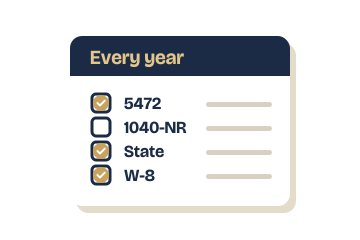
Foreign-Owned US LLC Taxes: What You Must File Each Year (2026 Overview)
You own a US LLC from abroad. The yearly filings in one page: Form 5472 and pro forma 1120 for the LLC, Form 1040-NR for you in some cases, state reports, W-8 forms, and what no longer applies. With deadlines and links to each guide.
Read the guide
Form 5472: Fax Number, Mailing Address and Why You Cannot E-File It
Where to send the Form 5472 and pro forma Form 1120 of a foreign-owned single-member LLC: the IRS fax number, the dedicated Ogden mailing address, why e-filing is not allowed, how to send a Form 7004 extension, and what to keep as proof.
Read the guideThis article is general information about US tax rules for foreign-owned LLCs, not advice for your specific situation. Rules change; check the date above and ask before you file.