Form W-8BEN: How to Fill It In Line by Line (2026 Guide for French Residents)
Form W-8BEN shows a US payer you are not a US person and lets you claim a treaty rate. Who files it, each line with an example, rates, validity and W-8BEN-E.
 Written by Amel Ouchene, IRS PTIN holderLast updated Not legal or tax advice18 min read

Form W-8BEN is a one-page certificate. A foreign individual gives it to a US payer: a client, a self-publishing platform, a broker, an ad network. It does two jobs. It shows that you are not a US person, and it lets you claim a reduced rate under the income tax treaty between your country and the United States. If the payer has no form on file, it may have to withhold 30% on certain income.
Unless another source is named, the rules below come from the Instructions for Form W-8BEN (Rev. October 2021, the current revision). This guide uses France as its example. It is general information, not legal or tax advice, and it does not cover how income is reported in your country of residence.
In short:
- Give the form to the payer, never to the IRS. The form says so at the top: "Do not send to the IRS."
- It is for individuals only. A company (a French SASU, SARL and so on) uses Form W-8BEN-E. A US person, even one living in France, uses Form W-9.
- Line 6a takes your foreign tax number. The instructions let you give it there, rather than a US number on line 5, to claim treaty benefits. The instructions generally require an ITIN only if you give no foreign tax number on line 6, and they list exceptions where an SSN or ITIN is required anyway (see line 6a below).
- Table 1 of the IRS treaty tables lists, for France: 0% on the royalty types it lists, 0% on interest paid by US obligors (with footnoted exceptions), and 15% on dividends in the general column, against 30% by default.
- The form is valid from signature until the last day of the third following calendar year, unless a change in circumstances makes it wrong. Signed in 2026, it runs through December 31, 2029.
What Form W-8BEN is for
Foreign persons are subject to US tax at a 30% rate on certain US-source income: interest, dividends, rents, royalties, premiums, annuities, compensation for services performed, and other fixed or determinable annual or periodical income. The instructions say this tax is generally collected by withholding at source. If you do not give the form, "the withholding agent may have to withhold at the 30% rate" (or at the backup withholding rate).
The form lets the payer know who it is paying:
- You are not a US person.
- You claim to be the beneficial owner of the income.
- If you are a resident of a country that has an income tax treaty with the United States, you can claim the reduced treaty rate.
The instructions also say the form may be used to claim an exception from US information reporting and backup withholding on some income that is not subject to 30% withholding, such as broker proceeds and bank deposit interest.
Payers usually ask for it before the first payment. The instructions say to give it to the person requesting it "before the payment is made to you."
Who gives a W-8BEN
You give a W-8BEN if you are a nonresident alien individual and a US payer or financial institution asks for it. The usual cases for someone resident in France:
| Your situation | Form |
|---|---|
| Author, musician or developer paid royalties by a US platform | W-8BEN |
| Individual investor holding US shares with a US broker | W-8BEN |
| Freelancer paid by a US client for work done from France | W-8BEN, if the client asks |
| Foreign sole owner of a US LLC that is not taxed as a corporation | W-8BEN in your own name (see below) |
| Your French company (SASU, SARL and similar) invoices the client | W-8BEN-E |
| US citizen or green card holder, even if living in France | W-9 |
| Income effectively connected with a US trade or business | W-8ECI |
| Claiming exemption from withholding on pay for personal services performed in the United States | Form 8233 or W-4 |
The form itself lists these exclusions at the top ("Do NOT use this form if"). Two details from the instructions: income allocable to you through a partnership is the exception to the W-8ECI rule, and a US citizen uses a W-9 "even if you reside outside the United States."
The freelancer case. Source depends on where the work is done. Publication 515 says: "The place where the services are performed determines the source of the income, regardless of where the contract was made, the place of payment, or the residence of the payer" (Publication 515). The instructions describe the 30% rate as applying to income received from US sources, and services performed entirely outside the United States do not produce US-source income under that rule, so the 30% rate on US-source income does not reach them. Publication 515 also says a payment is treated as US-source if its source cannot be determined at the time of payment. The client may still ask for a W-8BEN to document your foreign status. If part of the work is done in the United States, the allocation is different: see the Publication.
If you own a US LLC. The instructions say: "If you are the single owner of a disregarded entity, you are considered the beneficial owner of income received by the disregarded entity." You complete the W-8BEN in your own name, not the LLC's. The LLC's name and account number can go on line 7. (An exception: a disregarded entity claiming treaty benefits as a hybrid entity completes Form W-8BEN-E instead.) Our W-8BEN or W-9 form finder points to the right form for your LLC structure, and the glossary entry on Form W-8BEN covers the cases. For the entity side, see our guide to the W-8BEN-E for a US LLC owner.
Form W-8BEN line by line
Fictional example: Camille Laurent, a self-published author living in Lyon, receives royalties from a US platform on sales of her e-books in the United States. The name, address, birth date and tax number are all invented; the 13-digit number is a made-up sequence, not a real French tax number.
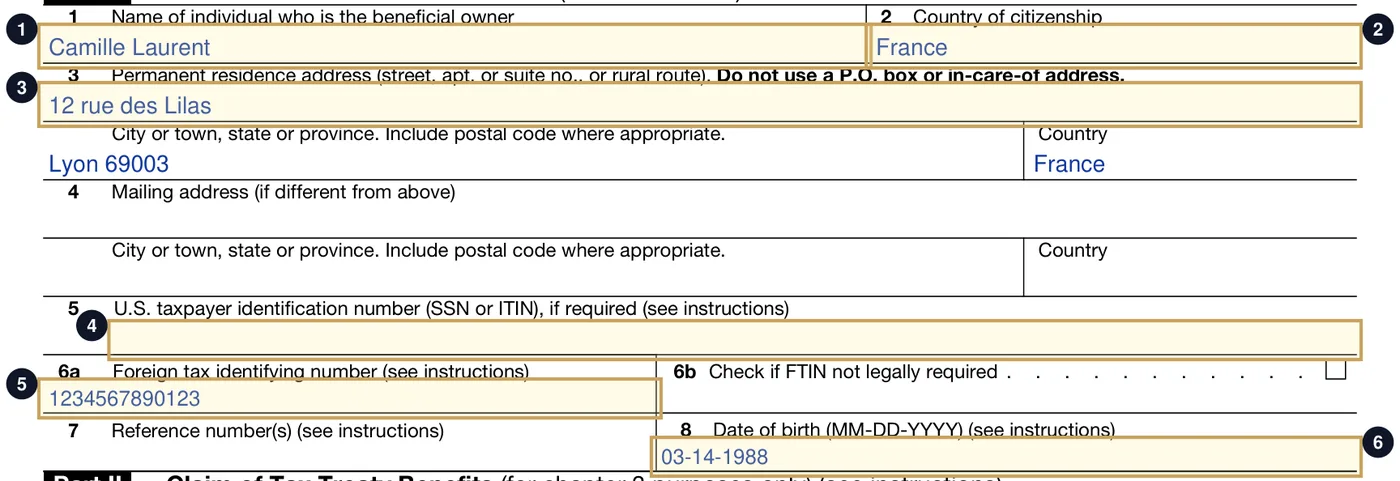
- 1Line 1: your name as on your ID
- 2Line 2: your country of citizenship
- 3Line 3: your tax residence address, no P.O. box
- 4Line 5: blank if you have no SSN or ITIN
- 5Line 6a: your French tax number
- 6Line 8: your date of birth, US format MM-DD-YYYY
Part I: identification
| Line | What it asks | What to write | Camille's example |
|---|---|---|---|
| 1 | Name of individual who is the beneficial owner | Your name as on your ID | Camille Laurent |
| 2 | Country of citizenship | Your citizenship. With dual citizenship, the country where you are both a citizen and a resident | France |
| 3 | Permanent residence address | The address in the country where you are a tax resident. The form says no P.O. box and no in-care-of address; the instructions add no financial institution address and no address used only for mailing | 12 rue des Lilas, Lyon 69003, France |
| 4 | Mailing address | Only if different from line 3 | Blank |
| 5 | U.S. taxpayer identification number | Your SSN or ITIN, if you have one | Blank |
| 6a | Foreign tax identifying number | Your French tax number | 1234567890123 (invented) |
| 6b | Check if FTIN not legally required | For account holders at a US financial institution who are not legally required to have a foreign tax number. Leave unchecked if you have a French tax number | Unchecked |
| 7 | Reference number(s) | Optional: an account number, or your LLC's name (see above) | Blank |
| 8 | Date of birth | Format MM-DD-YYYY | 03-14-1988 |
Line 6a, the foreign tax number. The instructions require it, with exceptions, when you document yourself as the holder of an account at a US office of a financial institution and receive US-source income reportable on Form 1042-S. They also say you may give it "for purposes of claiming treaty benefits (rather than providing a U.S. TIN on line 5, if required)." The instructions also say that, to claim treaty benefits, you are generally required to give an ITIN if you do not give a tax number issued by your country of tax residence on line 6, with a short list of exceptions (for example dividends and interest on actively traded stocks and debt obligations). So a French resident who gives a French tax number on line 6a generally does not need an ITIN for that claim. Two cautions from the instructions: an SSN or TIN is required if you submit the form to a partnership that conducts a US trade or business, and also if you claim an exemption under section 871(f) for certain annuities. Per the OECD's page on French tax numbers, the number has 13 digits and the first is always 0, 1, 2 or 3, written without spaces. It is the numéro fiscal de référence (or numéro SPI). It does not appear on the ID card or the passport. It is on the first page of the pre-filled income tax return ("N° Fiscal déclarant") and of the notice of assessment ("Numéro fiscal"). The OECD page adds that France issues the number once a person is identified as a taxpayer, for example after a first tax return, so a person who has never filed may not have one yet.
Line 8, the date of birth. The instructions ask for it when you document yourself as an account holder at a US office of a financial institution. Watch the US format, month first. March 14, 1988 is 03-14-1988.
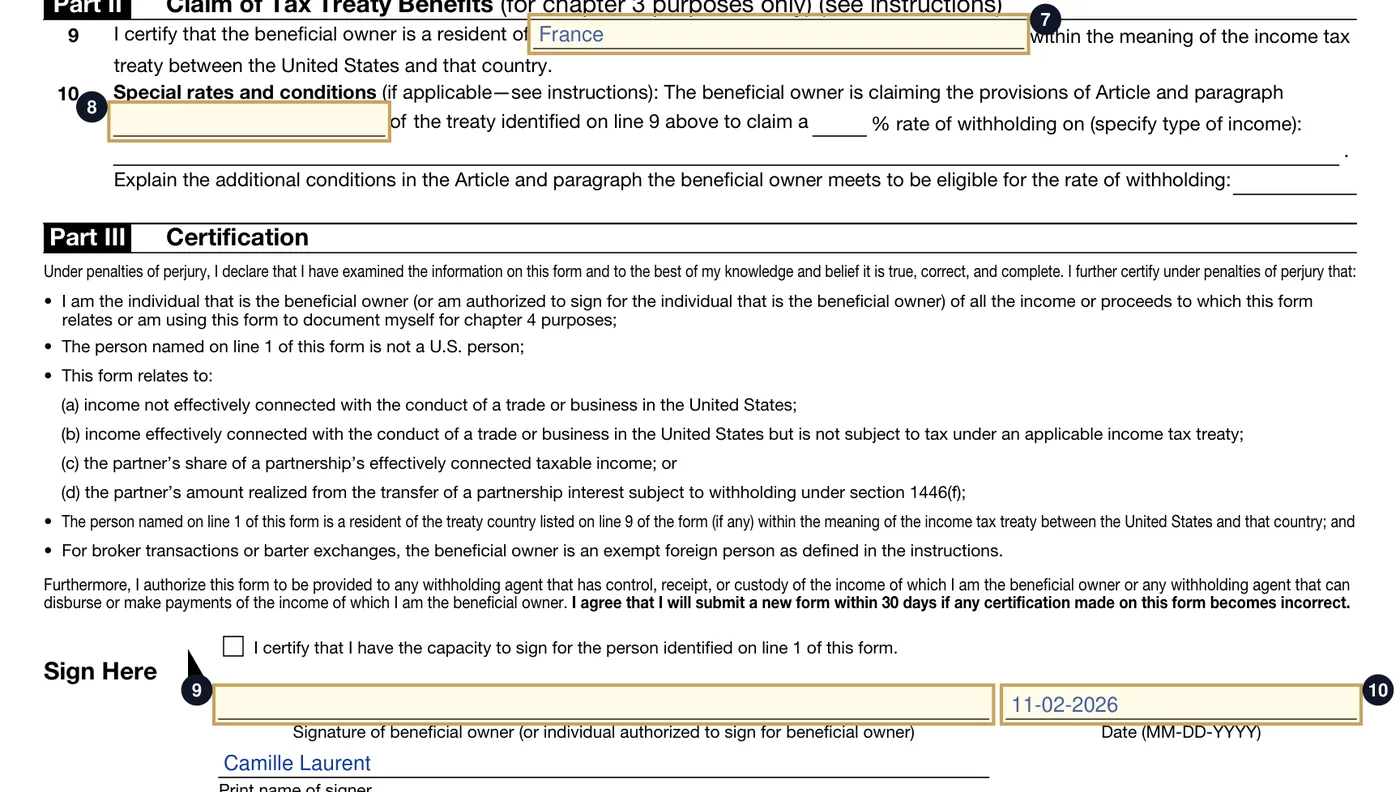
- 7Line 9: France, your country of residence under the treaty
- 8Line 10: usually blank for a French resident (see below)
- 9Handwritten signature, or electronic if the payer accepts it
- 10Date in MM-DD-YYYY format
Part II: claim of tax treaty benefits
- Line 9: write France if you are a resident of France within the meaning of the treaty. For treaty purposes, the instructions say, a person is a resident of a treaty country "if the person is a resident of that country under the terms of the treaty." You are certifying tax residence, not nationality.
- Line 10: per the instructions, line 10 is used only to claim treaty benefits that require conditions not covered by line 9 and Part III. It is "generally not applicable" to the interest article and to the dividends article (other than dividends at a preferential rate based on ownership). For royalties, you must complete it "if the treaty contains different withholding rates for different types of royalties." In Table 1, the four royalty columns for France that carry a rate (know-how and other industrial royalties, patents, film and TV, other copyrights) all show 0%, while the industrial equipment column shows "n/a". Because the royalty columns that carry a rate show the same rate, the "different rates" condition does not appear to apply to royalties from France, which would leave line 10 blank; this is our reading of the two documents, so follow the payer's instructions if it asks you to complete it. If a payer's questionnaire asks for the treaty article, Table 1 cites 12(1) / 2PIII in the royalties column (Article 12 of the treaty, as amended by the second protocol).
Part III: certification
- Sign and date (format MM-DD-YYYY), then print your name on the "Print name of signer" line.
- The box "I certify that I have the capacity to sign" is only for someone signing for another person, for instance under a power of attorney.
- Electronic signature: a withholding agent may allow one, but the instructions say "simply typing your name into the signature line is not an electronic signature." An acceptable one must indicate that the form was electronically signed by a person authorized to do so, for example with a time and date stamp and a statement. Platforms that have you complete the form online handle this step themselves.
By signing, you certify under penalties of perjury that the information is true, correct and complete, and you agree to submit a new form within 30 days if any certification becomes incorrect.
Withholding rates for a French resident
Table 1 of the IRS treaty tables (Rev. May 2023) gives, for France:
| US-source income | Default (no valid form) | Treaty rate in Table 1 | Treaty article citation in Table 1 |
|---|---|---|---|
| Royalties: know-how and other industrial royalties, patents, film and TV, other copyrights | 30% | 0% (footnote ss) | 12(1) / 2PIII |
| Interest paid by US obligors, general | 30% (but see below) | 0% (footnotes g, jj, ss) | 11(2) |
| Dividends from US corporations, general | 30% | 15% (footnote mm) | 10(2) / 2P2 |
Several points from the table's own text. The "direct dividend" rate (5%) is a separate column, for dividends that qualify for it, and is not the general rate for an individual investor. Footnote g says the exemption or reduced rate does not apply to an excess inclusion for a REMIC residual interest. Footnote ss says a 15% rate applies if the income is attributable to a permanent establishment the enterprise has in a third state and the tax actually paid there is less than 60% of the tax that would have been payable in the treaty country, unless the income is derived in the active conduct of a business in that third state. Footnote jj sets the rate on contingent interest that does not qualify as portfolio interest at 15% for France (the footnote lists 15% as the general figure, with other rates for named countries). Footnote mm says the rate in the general dividend column also applies to dividends paid by regulated investment companies and REITs, and for a REIT only if the beneficial owner meets one of its conditions (for an individual, holding not more than a 10% interest). The "30%" default for interest is the statutory rate: Publication 515 says interest that qualifies as portfolio interest is exempt from chapter 3 withholding. Table 1 covers income other than personal service income, so it has no row for pay for services. The table also warns that it "is not a comprehensive guide to all eligibility requirements" and tells readers to review the treaty text. A 0% rate does not mean the income is outside every tax system: how it is reported where you live is a separate question for a local adviser.
How long a W-8BEN stays valid
The instructions: a Form W-8BEN generally remains in effect from the date it is signed until "the last day of the third succeeding calendar year," unless a change in circumstances makes information on it incorrect. Their example: signed September 30, 2015, valid through December 31, 2018.
| Signed in | Valid through |
|---|---|
| 2026 | December 31, 2029 |
| 2027 | December 31, 2030 |
The instructions add that under certain conditions a form stays in effect indefinitely until a change of circumstances, with references to the regulations for chapters 3 and 4. A payer may also have its own renewal practices, so follow its request.
Change in circumstances. If any information becomes incorrect, you must notify the payer within 30 days and file a new form. For a French resident:
- If you use the form to certify foreign status, a change of address to the United States is a change in circumstances. A change of address within the same foreign country, or to another foreign country, generally is not.
- If you use the form to claim treaty benefits, a move to the United States, or outside the country where you have been claiming treaty benefits, is a change in circumstances.
- If you become a US citizen or resident alien, you must notify the payer within 30 days and may be required to provide a Form W-9. The instructions add that you may be a US resident for tax purposes depending on the days you spend in the United States over a three-year period (see Publication 519).
W-8BEN-E: for a company, not for you
Form W-8BEN-E is the entity version. If your French company invoices the US client or platform, the company completes a W-8BEN-E, in its own name and with its own number.
The form runs to 8 pages, but an ordinary operating company completes only part of it:
- Part I: the company's name, its country (France), line 4 for the chapter 3 status ("Corporation" for a company taxed as one), line 5 for its FATCA status, the permanent residence address (line 6), and line 9b for its foreign tax number. The OECD page says French entities use the numéro SIREN (9 digits).
- Line 5, FATCA status: an entity that is not a financial institution and has less than 50% passive gross income and less than 50% passive assets generally qualifies as an Active NFFE and certifies that in Part XXV.
- Part III: line 14a (country of residence under the treaty) and line 14b, which certifies that the entity derives the income and meets any limitation on benefits provision of the treaty.
- Part XXX: certification and signature.
The other statuses and parts are for banks, funds and investment structures. If your company mainly holds investments, it may not be an Active NFFE: have the status checked. Our guide to the W-8BEN-E for a US LLC owner goes through the parts in more detail.
Common mistakes
- Completing the W-8BEN for a company. It is for individuals. A SASU or SARL gives a W-8BEN-E.
- Putting your US LLC's name on line 1. For a single-owner LLC, your name goes on line 1. The LLC's name can go on line 7.
- Using a US address or a P.O. box on line 3. Line 3 asks for your permanent residence address in your country of tax residence, and the instructions exclude P.O. boxes and mailing-only addresses.
- Writing the date in French order. 03-14-1988, not 14/03/1988.
- Leaving line 6a blank when you claim treaty benefits. The instructions generally require an ITIN if you give no foreign tax number, so without either the payer may not be able to apply the treaty rate.
- Sending the form to the IRS. It goes to the payer, who keeps it.
- Letting it lapse. The instructions say that if you do not provide the form, the payer may have to withhold at 30%. Note the end of the validity period and give the payer a new form when it asks.
Your checklist
- I am an individual, and not a US citizen or US resident for tax purposes.
- Line 3: my tax residence address, no P.O. box.
- Line 6a: my French tax number.
- Line 8 and the signature date in MM-DD-YYYY format.
- Line 9: France.
- Signed, and given to the payer, not to the IRS.
- Reminder set to renew before December 31 of the third following year.
Official resources
- IRS, Form W-8BEN (PDF)
- IRS, Instructions for Form W-8BEN
- IRS, Instructions for Form W-8BEN-E
- IRS, Table 1: tax rates under tax treaties (PDF)
- IRS, Publication 515, Withholding of Tax on Nonresident Aliens and Foreign Entities
- IRS, Publication 519, U.S. Tax Guide for Aliens
- OECD, France: information on tax identification numbers (PDF)
Frequently asked questions
Do I send Form W-8BEN to the IRS?
No. The form says: "Give this form to the withholding agent or payer. Do not send to the IRS." You give it to the client, platform or broker that asked for it, and they keep it on file.
Do I need an ITIN to complete Form W-8BEN?
Not necessarily. The instructions let you give the foreign tax number issued by your country of tax residence on line 6a to claim treaty benefits, instead of a US number on line 5. Leave line 5 blank if you have no SSN or ITIN. An SSN or TIN is still required in some cases, for example when you submit the form to a partnership that conducts a US trade or business.
Where do I find my French tax number?
It is the numéro fiscal de référence (or numéro SPI): 13 digits, the first being 0, 1, 2 or 3, written without spaces. According to the OECD's page on France, it is on the first page of the pre-filled income tax return ("N° Fiscal déclarant") and of your notices of assessment ("Numéro fiscal"). It is not on the ID card or the passport.
Which treaty article do I cite for copyright royalties?
Table 1 cites 12(1) / 2PIII (Article 12, royalties, as amended by the second protocol), with 0% in the royalty columns for France that carry a rate. The instructions require line 10 for royalties only when the treaty has different rates for different types of royalties, which does not appear to be the case here (our reading). If a platform's online questionnaire asks, give that citation and follow the platform's instructions.
I freelance from France for a US client. Will they withhold 30%?
Normally not on pay for work done outside the United States. Under Publication 515, the place where services are performed determines the source of the income, so work done from France is foreign-source income and does not fall under the 30% rate on US-source income (a payment whose source cannot be determined at the time of payment is treated as US-source). The W-8BEN the client requests documents that you are not a US person. If some of the work is done in the United States, the rules differ.
I own a US LLC. Who completes the W-8BEN?
If you are the single owner and the LLC has not elected to be taxed as a corporation, you complete it in your own name. The instructions treat the single owner of a disregarded entity as the beneficial owner of the income. If the income is effectively connected with a US trade or business, the form is the W-8ECI. Our form finder gives the answer in three questions, and the glossary entry details the cases.
This article is general information, not legal or tax advice. Melya prepares documents from what you provide and does not represent clients before the IRS. Rules change, so check the current IRS forms and instructions.
Keep reading
Form W-8BEN-E for a US LLC Owner: Who Must Use It and How to Fill It In
Does your US LLC give a W-8BEN-E? Usually not: its foreign owner does. W-8BEN, W-8BEN-E, W-8ECI or W-9, the main parts of the form, active or passive NFFE, how long it stays valid, and what to do when a platform insists on a W-9.
Read the guideFiling Form 5472 by Fax or Mail: What Proof of Sending Exists and How to Keep It
Learn what proof exists when submitting Form 5472 by fax or mail, what a transmission report shows, and how to keep records of your filing.
Read the guideThis article is general information about US tax rules for foreign-owned LLCs, not advice for your specific situation. Rules change; check the date above and ask before you file.