W-8 Forms: Which One Do You Need? W-8BEN, W-8BEN-E, W-8ECI, W-8EXP, W-8IMY
What a W-8 form is, the five forms in the family and who signs each one, how long a W-8 stays valid, what the owner of a US LLC gives, and what happens when a US payer pays a foreign contractor without a W-8BEN.
 Written by Amel Ouchene, IRS PTIN holderLast updated Not legal or tax advice9 min read
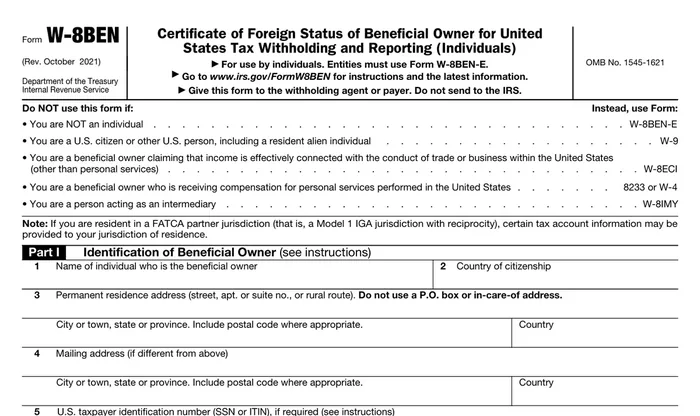
A W-8 form tells a US payer that the person it pays is not a US person for tax purposes. There is no single "Form W-8": the IRS publishes five certificates of foreign status (a sixth form, W-8CE, is a notice for covered expatriates), and each one fits a different payee. This guide shows which one you need, how long it lasts, which one the foreign owner of a US LLC signs, and what happens on the payer's side when a foreign contractor is paid without one. The rules come from the IRS instructions for each form and from Publication 515 (2026).
In short:
- W-8BEN: a foreign individual. W-8BEN-E: a foreign entity. W-8ECI: income effectively connected with a US business. W-8EXP: foreign governments and certain tax-exempt organizations. W-8IMY: intermediaries and flow-through entities.
- Not for the IRS: you give the form to the payer or bank that asks for it. The W-8BEN instructions say "Do not send Form W-8BEN to the IRS."
- Validity: generally from the date signed to the last day of the third following calendar year, unless something on the form becomes incorrect.
- US LLC with one foreign owner: the owner documents themself, usually on a W-8BEN as an individual. The LLC does not sign a W-9.
- Foreign contractor without a W-8: the payer must apply the IRS presumption rules, and the payer is personally liable for any tax it should have withheld.
What a W-8 form does
US payers have to know who they pay. A US person gives a Form W-9 with a taxpayer number. A foreign person gives a Form W-8, which establishes foreign status and, where it applies, claims a reduced rate of withholding under a tax treaty. Publication 515 puts the stakes plainly: "Foreign persons who provide a valid Form W-8 (or applicable documentary evidence when permitted in lieu of a Form W-8) are exempt from backup withholding and Form 1099 reporting."
The form is kept by the payer. You do not file it with the IRS.
The five W-8 forms compared
| Form | Who signs it | Typical case |
|---|---|---|
| W-8BEN | A foreign individual who is the beneficial owner of the income | A freelancer, an author paid royalties, the foreign owner of a single-member US LLC |
| W-8BEN-E | A foreign entity that is the beneficial owner | A French SAS or a Swiss GmbH paid by a US client |
| W-8ECI | A foreign person whose US-source income is effectively connected with a US trade or business | A foreign owner who runs a business in the United States and reports the income on a US return |
| W-8EXP | Foreign governments, international organizations, foreign central banks of issue, certain foreign tax-exempt organizations | Rare for business owners |
| W-8IMY | Intermediaries (agents, nominees, custodians) and flow-through entities such as foreign partnerships | A foreign partnership collecting income for its partners |
The W-8BEN instructions list the cases where it is the wrong form: a foreign entity uses the W-8BEN-E; a US citizen or resident alien uses a W-9; an intermediary uses the W-8IMY; an individual claiming exemption on pay for services performed in the United States uses Form 8233 or Form W-4; and effectively connected income goes on a W-8ECI, unless it is allocable to you through a partnership.
Two points about the W-8ECI. It is not for treaty claims on other income: for that, the instructions send you back to the W-8BEN or W-8BEN-E. And it needs a US taxpayer number: "You are required to provide a TIN for this form to be valid."
Which form the foreign owner of a US LLC signs
A single-member LLC is disregarded for US income tax unless it elected to be taxed as a corporation. For a W-8, that means the LLC does not document itself; its owner does. The W-8BEN-E instructions say a disregarded entity generally does not use that form, except in narrow cases. Form W-9 is just as clear about the other half: if the owner of a disregarded entity is a foreign person, "the owner must complete an appropriate Form W-8 instead of a Form W-9. This is the case even if the foreign person has a U.S. TIN."
So a foreign individual who owns the LLC alone gives a W-8BEN in their own name. Line 1 is the owner's name. The W-8BEN instructions allow the LLC's name and account number to be shown on line 7, the reference number, so the payer can match the form to the account. If the owner is a company, that company gives a W-8BEN-E. Our guides on the W-8BEN-E for a US LLC owner and the W-8BEN line by line go into each box, and what to send when a bank asks for a W-9 covers the usual mix-up.
How long a W-8 stays valid
The W-8BEN instructions say a form generally stays in effect "for a period starting on the date the form is signed and ending on the last day of the third succeeding calendar year". Their example: a form signed on September 30, 2015 remains valid through December 31, 2018. Some forms stay valid indefinitely under the regulations.
The period ends early if something on the form becomes incorrect. You must then notify the payer within 30 days and give a new form. Moving to a US address is a change in circumstances; so is a move out of the treaty country if you claimed treaty benefits. Becoming a US citizen or resident alien means you switch to a W-9.
Paying a foreign contractor without a W-8BEN: what the payer risks
This part is for the payer, including a foreign-owned US LLC that pays freelancers abroad.
First question: is the payment even subject to US withholding? Under Publication 515, a payment is subject to chapter 3 withholding if it is US-source FDAP income, or if withholding is specifically required. For personal services, "the place where the services are performed determines the source of the income, regardless of where the contract was made, the place of payment, or the residence of the payer." A contractor who works entirely abroad earns foreign-source income from those services.
Second question: can the payer prove who it paid? That is what the W-8BEN is for. Publication 515 says that if a payer "cannot reliably associate a payment with valid documentation, you must apply certain presumption rules or you may be liable for tax, interest, and penalties." The presumption rules decide whether the payee is treated as an individual or an entity (Regulations section 1.1441-1(b)(3)(ii)) and as a US or a foreign person (section 1.1441-1(b)(3)(iii)).
The general default is a US person: the payee then falls under Form 1099 reporting, and a US payee who has not given a taxpayer number triggers backup withholding at 24%. Contractors have a specific rule: a payment for services is presumed made to a foreign person if the payee is an individual, the payer does not know or have reason to know that the payee is a US citizen or resident or that the income is (or may be) effectively connected with a US trade or business, and all the services were performed outside the United States (section 1.1441-1(b)(3)(iii)(E)).
A payee presumed foreign cannot get a reduced rate, because "you are not permitted to apply a reduced rate of chapter 3 withholding based on a payee's presumed status if documentation is required to establish a reduced rate of withholding." The presumption depends on what the payer knows; a signed W-8BEN replaces it with documentation.
Third: who pays if tax was not withheld? Publication 515: "As a withholding agent, you are personally liable for any tax required to be withheld. This liability is independent of the tax liability of the foreign person to whom the payment is made." The tax is collected only once, but interest and penalties can remain with the payer.
Reporting. Payments subject to chapter 3 reporting go on Form 1042-S, with an annual Form 1042. Publication 515 gives March 15, 2027 as the due date of the 2026 Forms 1042-S. Whether a given contractor payment must be reported depends on the facts; our Form 1099-NEC guide covers the US-payee side.
In practice: before the first payment, ask each foreign contractor for a signed W-8BEN (or W-8BEN-E for a company), check the name and country, and keep it with the invoices. It costs the contractor a few minutes and gives the payer the documentation the rules expect.
How Melya helps
Melya prepares the US tax forms of foreign owners of US LLCs and signs as paid preparer; Melya does not represent clients before the IRS and does not advise on the tax rules of your country of residence. The W-8BEN or W-8BEN-E preparation costs $69. Platform Tax Setup ($79) puts the right W-8, treaty claim and matching names into Stripe, Amazon, PayPal or Upwork.
Related reading: W-8BEN and W-8BEN-E for Swiss residents and companies
Frequently asked questions
What is a W-8 (or W8) form, in one sentence?
A certificate that a payee is not a US person, given to the US payer so it can apply the right withholding and reporting.
W-8BEN or W-8BEN-E: which one for my US LLC?
If you are an individual and the only owner of the LLC, and it has not elected to be taxed as a corporation, you sign a W-8BEN in your own name. A W-8BEN-E is for a foreign entity, for example a foreign company that owns the LLC.
How long is a W-8 valid, and does a W-8BEN-E expire?
Yes, in the same way as the W-8BEN. The instructions of both the W-8BEN and the W-8BEN-E say the form generally stays in effect "for a period starting on the date the form is signed and ending on the last day of the third succeeding calendar year": a form signed on September 30, 2015 remains valid through December 31, 2018. Some forms stay valid indefinitely under the regulations. The period ends early if something on the form becomes incorrect: you must then notify the payer within 30 days and give a new form. Always check the instructions of the exact form you sign.
Do I send the W-8 to the IRS?
No. You give it to the payer, platform or bank that asked for it.
When do I need a W-8ECI instead of a W-8BEN?
When the income is effectively connected with a US trade or business and you will report it on a US return. The form needs a US taxpayer number to be valid.
What is the penalty for not getting a W-8BEN from a foreign contractor?
There is no single fixed fine. Without documentation the payer applies the presumption rules; if that leads to tax that should have been withheld and was not, the payer is personally liable for it, plus interest and penalties. For an individual contractor who performs all the work abroad, the regulations presume a foreign payee unless the payer knows or has reason to know otherwise, and the pay for that work is generally foreign-source; the W-8BEN turns that presumption into documentation.
Sources
- IRS, Instructions for Form W-8BEN (Rev. October 2021): who uses it, other forms, expiry, change in circumstances, line 7.
- IRS, Instructions for Form W-8BEN-E: entities and disregarded entities.
- IRS, Instructions for Form W-8ECI: who must provide it, US TIN requirement.
- IRS, Instructions for Form W-8EXP and Instructions for Form W-8IMY.
- 26 CFR 1.1441-1(b)(3): presumption rules, including payments for services performed outside the United States.
- IRS, Publication 515 (2026), Withholding of Tax on Nonresident Aliens and Foreign Entities: liability for tax, presumption rules, source of personal service income, Form 1042-S.
- IRS, Form W-9 (Rev. March 2024): foreign owner of a disregarded entity.
Keep reading
Form W-8BEN-E Instructions for a US LLC Owner: Who Must Use It and How to Fill It In
Does your US LLC give a W-8BEN-E? Usually not: its foreign owner does. W-8BEN, W-8BEN-E, W-8ECI or W-9, the main parts of the form, active or passive NFFE, how long it stays valid, and what to do when a platform insists on a W-9.
Read the guideForm W-8BEN: How to Fill It In Line by Line (2026 Guide for French Residents)
Form W-8BEN shows a US payer you are not a US person and lets you claim a treaty rate. Who files it, each line with an example, rates, validity and W-8BEN-E.
Read the guideForm 1042-S Explained: What It Is, Who Sends It, and What a Foreign Person or US LLC Does With It
Form 1042-S reports US-source income paid to a foreign person and the tax withheld on it. What the boxes mean, the March 15 deadline, when a foreign-owned US LLC must issue one, and how a recipient uses it to claim back tax on Form 1040-NR.
Read the guideThis article is general information about US tax rules for foreign-owned LLCs, not advice for your specific situation. Rules change; check the date above and ask before you file.