Form W-8BEN and W-8BEN-E for Switzerland: Swiss Residents and Swiss Companies
Which W-8 a Swiss resident or a Swiss company gives a US payer, the Swiss tax number to enter, how to claim the US-Switzerland treaty (0% on interest and royalties, 15% or 5% on dividends), and the case of a US LLC owned from Switzerland.
 Written by Amel Ouchene, IRS PTIN holderLast updated Not legal or tax advice6 min read
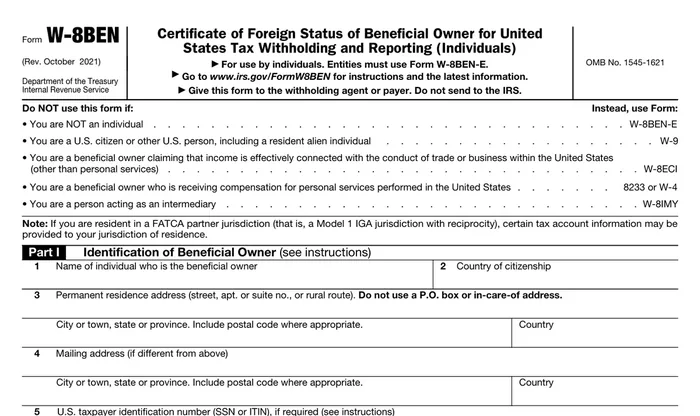
A US payer asks you, from Switzerland, for a "W-8BEN" or a "W-8BEN-E". The first is for a person, the second for a company. Both tell the payer you are not a US person and let you claim the reduced rates of the US-Switzerland tax treaty. This guide covers the choice of form, the Swiss tax number to enter, the treaty lines and the case of a US LLC owned from Switzerland. The rules come from the IRS instructions for both forms, the IRS treaty tables and the OECD's information sheet on Swiss tax numbers.
In short:
- A person resident in Switzerland: Form W-8BEN. A Swiss company (AG/SA, GmbH/Sàrl): Form W-8BEN-E. (W-8ECI instead for income effectively connected with a US trade or business.)
- A US single-member LLC owned by a Swiss resident: the owner gives a W-8BEN in their own name, not the LLC.
- Swiss tax number: Switzerland designates the AHV/AVS number for individuals and the UID number (CHE-…) for entities as tax identification numbers for automatic exchange of information (use of the AHV number is restricted, see below).
- Treaty rates (IRS table): 0% on interest and royalties, 15% on dividends (5% for a company directly owning at least 10% of the voting stock), against 30% without a treaty claim.
- The form goes to the payer, never to the IRS, and stays valid until the end of the third calendar year after signature unless something changes.
W-8BEN or W-8BEN-E?
The W-8BEN instructions say not to use the W-8BEN if "you are a foreign entity documenting your foreign status, documenting your chapter 4 status, or claiming treaty benefits. Instead, use Form W-8BEN-E." So:
| You are | Form |
|---|---|
| A person living in Switzerland (freelancer, author, investor) | W-8BEN |
| A Swiss AG/SA or GmbH/Sàrl paid by a US client or platform | W-8BEN-E |
| A Swiss resident who owns a US single-member LLC (no corporate election) | W-8BEN, in the owner's name |
| A Swiss company that owns a US single-member LLC | W-8BEN-E, in the Swiss company's name |
| A US citizen or green-card holder living in Switzerland | W-9, not a W-8 |
For the US LLC, the W-9 says that if the owner of a disregarded entity is a foreign person, "the owner must complete an appropriate Form W-8 instead of a Form W-9." The W-8BEN instructions allow the LLC's name and account number on line 7, the reference number, so the payer can match the form to the account.
The Swiss tax number (line 6a of the W-8BEN, line 9b of the W-8BEN-E)
The W-8BEN asks for the "foreign tax identifying number (FTIN) issued to you by your jurisdiction of tax residence". It is mandatory in some cases, for example for an account at a US office of a financial institution receiving income reported on Form 1042-S, and you may give it to claim treaty benefits instead of a US number.
According to the information sheet Switzerland gave the OECD:
- Individuals: the Old-age and Survivors' Insurance number (AHV/AVS number) is designated "as the tax identification number for individuals in the context of AEOI" (automatic exchange of information).
- Entities: the UID number is the tax identification number for entities for automatic exchange of information, with the structure CHE-999.999.99C.
The same sheet adds that systematic use of the AHV/AVS number is restricted under Swiss law: the number "must remain confidential" and may be used systematically only by financial institutions of Switzerland's partner jurisdictions for automatic exchange of information. The IRS instructions do not name a Swiss number. If you are unsure which number to give a US payer, ask the payer or a Swiss adviser; Melya does not advise on Swiss rules.
Claiming the US-Switzerland treaty
On the W-8BEN (Part II): line 9 names the country where you are resident for treaty purposes, here Switzerland. Line 10 is only for claims that need extra conditions; the instructions say it is "generally not applicable to treaty benefits under an interest or dividends (other than dividends subject to a preferential rate based on ownership) article", but it is needed for royalties when the treaty has different rates for different types of royalties, and for business profits not attributable to a permanent establishment.
On the W-8BEN-E (Part III): line 14a names the country of residence, and on line 14b the company certifies that it derives the income and "meet[s] the limitation on benefits provision contained in the treaty, if any," then ticks the box for the limitation-on-benefits test it meets. For a Swiss company, that provision is Article 22 of the treaty; which test the company meets depends on its owners and activity, so check it before signing. A Swiss company claiming the 5% dividend rate also completes line 15 (special rates and conditions), citing Article 10(2)(a).
The IRS treaty table gives for Switzerland:
| Income | Treaty rate | Treaty article |
|---|---|---|
| Interest | 0% | 11(1) |
| Royalties | 0% | 12(1) |
| Dividends, general | 15% | 10(2) |
| Dividends, company directly owning at least 10% of the voting stock | 5% | 10(2) |
The IRS warns that the table "is not a comprehensive guide to all eligibility requirements"; it notes, for instance, a 30% rate for Switzerland on contingent interest that does not qualify as portfolio interest. Our US-Switzerland treaty guide covers business profits, the permanent establishment test and Form 8833.
How long it lasts, and where it goes
The W-8BEN instructions say a form generally stays in effect from the date it is signed "ending on the last day of the third succeeding calendar year, unless a change in circumstances makes any information on the form incorrect." If you claimed the treaty and you move out of Switzerland, or to the United States, you must notify the payer within 30 days. The form is never sent to the IRS: you give it to the payer, platform or bank that asked for it.
How Melya helps
Melya prepares the W-8BEN or W-8BEN-E that matches your structure for your signature, for $69. Platform Tax Setup ($79) puts the right W-8, treaty claim and matching names into Stripe, Amazon, PayPal or Upwork. Melya signs as paid preparer on the returns it prepares; it does not represent clients before the IRS and does not advise on Swiss tax rules.
Frequently asked questions
Which W-8 does a Swiss GmbH or AG give a US client?
The W-8BEN-E, in the company's name, with its UID number as foreign tax number and Switzerland on line 14a if it claims the treaty.
I live in Switzerland and own a US LLC. Who signs?
If the LLC has one owner and no corporate election, you do, on a W-8BEN in your own name (a W-8ECI instead if the income is effectively connected with a US trade or business). The LLC's name can go on line 7.
Can I enter my AHV/AVS number on the W-8BEN?
Switzerland designates the AHV/AVS number as the tax identification number for individuals for automatic exchange of information, but Swiss law restricts its systematic use and says it "must remain confidential". The IRS instructions do not name a Swiss number. Ask the payer which number it needs, or a Swiss adviser; Melya does not advise on Swiss rules.
What withholding applies without a W-8?
Without valid documentation, a US payer may have to apply the presumption rules and withhold 30% on US-source income such as dividends, interest or royalties. Our W-8 forms guide explains the payer's side.
Does the W-8 replace a US tax return?
No. It documents your status with a payer. Whether you or your LLC also files a US return (Form 1040-NR, Form 5472) is a separate question.
Sources
- IRS, Instructions for Form W-8BEN (Rev. October 2021): who uses it, lines 6a, 7, 9 and 10, expiry, change in circumstances.
- IRS, Instructions for Form W-8BEN-E (Rev. October 2021): lines 14a and 14b, limitation on benefits.
- IRS, Tax Treaty Tables, Table 1: rates for Switzerland.
- IRS, United States-Switzerland Tax Treaty documents: Articles 10, 11, 12 and 22.
- OECD, Switzerland: Information on Tax Identification Numbers: AHV/AVS number and UID number.
- IRS, Form W-9 (Rev. March 2024): foreign owner of a disregarded entity.
Keep reading
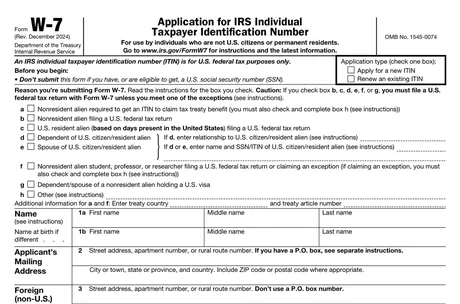
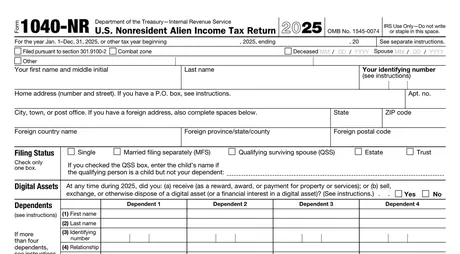
US-Switzerland Tax Treaty for a Foreign-Owned US LLC: What It Changes and What It Doesn't
What the US-Switzerland income tax treaty does for the owner of a US LLC who is a resident of Switzerland: business profits and permanent establishment, royalties, interest, dividends, and how to claim it (W-8BEN, 1040-NR with Form 8833).
Read the guide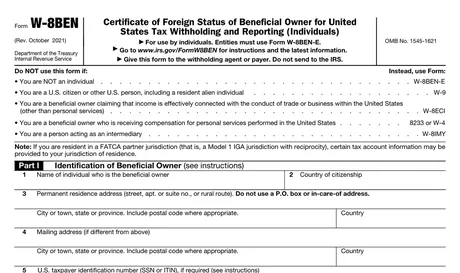
W-8 Forms: Which One Do You Need? W-8BEN, W-8BEN-E, W-8ECI, W-8EXP, W-8IMY
What a W-8 form is, the five forms in the family and who signs each one, how long a W-8 stays valid, what the owner of a US LLC gives, and what happens when a US payer pays a foreign contractor without a W-8BEN.
Read the guideForm W-8BEN-E Instructions for a US LLC Owner: Who Must Use It and How to Fill It In
Does your US LLC give a W-8BEN-E? Usually not: its foreign owner does. W-8BEN, W-8BEN-E, W-8ECI or W-9, the main parts of the form, active or passive NFFE, how long it stays valid, and what to do when a platform insists on a W-9.
Read the guideThis article is general information about US tax rules for foreign-owned LLCs, not advice for your specific situation. Rules change; check the date above and ask before you file.