US-Switzerland Tax Treaty for a Foreign-Owned US LLC: What It Changes and What It Doesn't
What the US-Switzerland income tax treaty does for the owner of a US LLC who is a resident of Switzerland: business profits and permanent establishment, royalties, interest, dividends, and how to claim it (W-8BEN, 1040-NR with Form 8833).
 Written by Amel Ouchene, IRS PTIN holderLast updated Not legal or tax advice9 min read
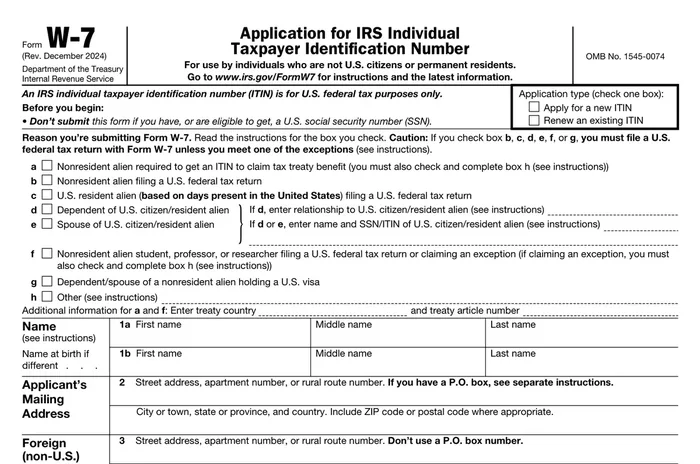
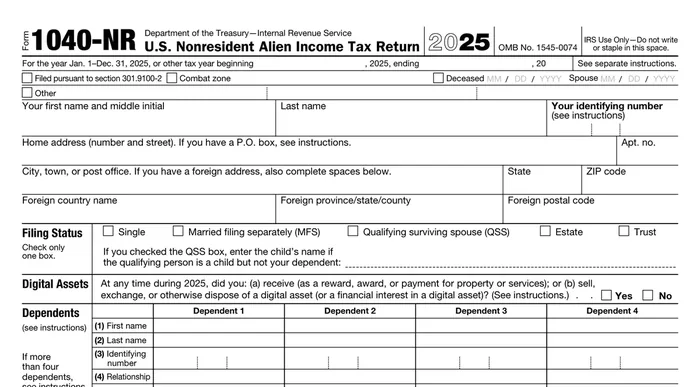
If you live in Switzerland and own a US LLC, you have probably heard that "the treaty protects you". The treaty is real, and it can reduce or remove US tax on some income. But it is a claim you make on a form, it only covers certain kinds of income, and it does not replace the filings your LLC owes on its own. This guide sets out what the text of the treaty and the IRS instructions say, from the US side only.
In short:
- Who is the taxpayer. For a single-member LLC that has not elected corporate status, the IRS instructions say the owner, not the LLC, gives the Form W-8BEN. The owner is treated as the person who receives the income.
- Business profits (Article 7). They are "taxable only in that State" (Switzerland) unless the enterprise carries on business in the United States "through a permanent establishment situated therein". Without a US permanent establishment, the treaty can remove US tax on business profits that US domestic law would otherwise tax.
- Passive income. The IRS treaty table shows 0% for interest and for royalties and 15% for dividends (5% for a company owning at least 10% of the voting stock), with conditions.
- How you claim it. On a W-8BEN given to the payer, or on a Form 1040-NR with Form 8833 attached. Failing to disclose a treaty position on Form 8833 can bring a $1,000 penalty.
- Not covered here. Whether and how Switzerland taxes your LLC and its income is a Swiss-law question. This guide does not answer it.
Step 1: is there any US income for a treaty to reduce?
A treaty never creates a right to tax-free money on its own. It reduces US tax that would otherwise apply. So ask first:
- Is any of the LLC's income US-source or effectively connected with a US trade or business? Publication 519 says "if you perform personal services in the United States at any time during the tax year, you are usually considered engaged in a trade or business in the United States", and that if you "own and operate a business in the United States selling services, products, or merchandise, you are, with certain exceptions, engaged in a trade or business in the United States". For personal services, Publication 515 says the place where the services are performed determines the source.
- Does the LLC receive US-source passive income (interest, royalties, dividends) that a payer may withhold 30% on?
If the answer to both is no, there is typically nothing for the treaty to reduce, and your obligations are the LLC's own filings (see what a foreign-owned US LLC files each year). If the answer to either is yes, the treaty may matter.
Step 2: the treaty must apply to you
- You must be a "resident" under the treaty. Article 4 defines a resident of Switzerland as a person liable to tax there "by reason of his domicile, residence, nationality, place of management, place of incorporation, or any other criterion of a similar nature". Paragraph 2 excludes a person who "is liable to tax in that State in respect only of income from sources in that State". Paragraph 5 says an individual who would be a Swiss resident but "elects not to be subject to the generally imposed income taxes in Switzerland with respect to all income from sources in the United States" is not treated as a Swiss resident for the treaty. Check which category you are in before you claim.
- Limitation on Benefits. Article 22 lets a Swiss resident claim the treaty's benefits if the person "is an individual" (first item of the list). A Swiss-resident individual who owns the LLC passes this test. Companies and trusts face more conditions.
- Partnerships and similar entities. Article 4 also treats "a partnership, estate, or trust" as a resident "only to the extent that the income derived ... is subject to tax in that State in the same manner as the income of a resident". A US single-member LLC is disregarded for US purposes, so the US sees the income as yours. How Switzerland treats the LLC is a Swiss-law question; ask a Swiss tax adviser.
- US citizens and green-card holders. Article 4 has special rules for a "United States citizen or alien lawfully admitted for permanent residence". This guide is for a non-US person.
The IRS lists for Switzerland the 1996 convention and a protocol signed on September 23, 2009. Its technical explanation says the protocol revises Article 10(3) (dividends paid to pension arrangements), adds binding arbitration to Article 25 and replaces Article 26 (exchange of information). The IRS table below is dated May 2023: check the current version before you rely on a rate.
Business profits and permanent establishment
Article 7 is the key provision for an LLC that sells services or goods:
"The business profits of an enterprise of a Contracting State shall be taxable only in that State unless the enterprise carries on business in the other Contracting State through a permanent establishment situated therein."
Article 5 defines a permanent establishment as "a fixed place of business through which the business of an enterprise is wholly or partly carried on". It includes an office, a branch, a place of management or a workshop, and a building site lasting more than twelve months. It does not include, for example:
- the use of facilities "solely for the purpose of storage, display or delivery of goods or merchandise belonging to the enterprise";
- a stock of goods kept "solely for the purpose of storage, display or delivery";
- a fixed place used solely for purchasing goods, collecting information, advertising, the supply of information, scientific research, or "other activities which have a preparatory or auxiliary character".
It does include a person who is not an independent agent and who has, and "habitually exercises", authority "to conclude contracts in the name of the enterprise". Whether your facts fit (for example inventory held for your own goods, or a US-based person who signs contracts for you) is a case-by-case question.
For independent personal services, Article 14 says income that an individual resident of a Contracting State derives from them "shall be taxable only in that State, unless the individual has a fixed base regularly available to him in the other Contracting State for the purpose of performing his activities".
Interest, royalties and dividends
For US-source income that is not effectively connected, the IRS treaty table (Table 1, Rev. May 2023) shows for Switzerland:
| Income | Treaty rate | Where |
|---|---|---|
| Interest | 0% | Article 11(1) |
| Royalties | 0% | Article 12(1) |
| Dividends, general | 15% | Article 10(2) |
| Dividends, company owning at least 10% of the voting stock | 5% | Article 10(2) |
The IRS warns that the table "is not a comprehensive guide to all eligibility requirements", and there are exceptions. For instance, the table notes a 30% rate for Switzerland on "contingent interest" that does not qualify as portfolio interest. Read the footnotes and the treaty article for your income.
Without a treaty or a valid form, the payer may have to withhold 30%. See bank asks for a W-9 for how withholding works.
How you claim it
With a payer (platform, bank, client): Form W-8BEN. The IRS instructions say the owner of a disregarded entity "rather than the disregarded entity itself, must submit the appropriate Form W-8BEN". You show the LLC's name and account number in the reference-number line if the payments go to the LLC. For treaty benefits you identify your country of residence on line 9. You are "generally required to provide an ITIN" if you do not provide on line 6 a tax identifying number issued by your country of tax residence. See Form W-8BEN line by line.
On your US return: Form 1040-NR with Form 8833. A treaty-based return position is generally disclosed on Form 8833: "Failure to disclose a treaty-based return position may result in a penalty of $1,000". The instructions waive disclosure for some positions, including a treaty position reducing tax on FDAP income when the beneficial owner is an individual. A position that you owe no US tax on business profits for lack of a permanent establishment is not in the list of waivers we checked, so assume Form 8833 is needed and confirm it. If you would not otherwise have to file, the instructions say you must still file a return to make the disclosure. Our guide to Form 1040-NR for a foreign LLC owner explains when a 1040-NR is required.
What the treaty does not do
- It is not automatic. Without a form or a disclosure, a payer or the IRS applies US law.
- It does not change your LLC's own US filings or the state-level rules. Sales tax and state income tax are separate questions.
- It says nothing about how Switzerland taxes you.
What Melya can do
- Form 1040-NR (Assessment), $95. We tell you in writing whether you owe a US personal return.
- W-8BEN or W-8BEN-E Preparation, $69. We prepare the form that matches your structure for your signature.
- Creators: Recover US Tax Withheld, from $199. If a platform withheld 30%, we prepare your W-8BEN to claim the treaty rate and, if you are eligible, your 1040-NR for your signature. Any refund depends on the IRS and is not guaranteed.
- File for Your French or Swiss Accountant, $149. Your LLC's figures and US filings in one file your accountant can use.
Melya is a tax preparation business whose founder holds a PTIN. We do not represent you before the IRS, we do not give legal advice and we do not advise on Swiss tax.
Related guides
- Form 1040-NR: do you need to file as a foreign LLC owner?
- Form W-8BEN line by line
- Form W-8BEN-E for a US LLC owner
- Substantial presence test
- US-France tax treaty for a foreign-owned US LLC
Frequently asked questions
Does the US-Switzerland treaty mean my US LLC pays no US tax?
No. It reduces US tax on some income if you are a treaty resident and meet its conditions. If the LLC has US-source income or a US trade or business, the treaty has to be claimed on the right form.
Does a US LLC owned by a Swiss resident have a permanent establishment in the US?
Not automatically. Article 5 requires a fixed place of business or a dependent agent with authority to conclude contracts. Storage and delivery of your own goods are excluded from the definition. Your facts decide.
Which form do I give a platform that withholds 30%?
The owner of a single-member LLC gives a Form W-8BEN, with the treaty country on line 9 and a tax identification number as the instructions require.
Do I need Form 8833?
Generally yes when you take a treaty-based position on your return, unless the IRS instructions waive it. The penalty for not disclosing is $1,000.
Is the rate on royalties really 0%?
The IRS table shows 0% under Article 12(1) for Switzerland, subject to the treaty's conditions and the footnotes. Check them against your payment.
Can I rely on this page for my Swiss taxes?
No. It covers the US side only.
Sources
- IRS, Convention between the United States and the Swiss Confederation (1996), Articles 4, 5, 7, 14, 22, and IRS Switzerland tax treaty documents (2009 protocol and technical explanation).
- IRS, Tax Treaty Tables, Table 1 (Rev. May 2023): interest, dividends, footnotes; royalties continue in the same table.
- IRS, Instructions for Form W-8BEN (Rev. October 2021): disregarded entity, lines 6, 9.
- IRS, Form 8833, Treaty-Based Return Position Disclosure: who must file, exceptions, penalty.
- IRS, Publication 519, U.S. Tax Guide for Aliens: trade or business in the United States.
- IRS, Publication 515: withholding, source of personal services income.
This page applies the IRS instructions and the treaty text. It is not legal or tax advice and does not cover the tax law of Switzerland.
See also. Living in Switzerland? Our page on a US LLC for Swiss residents puts the US filings and the usual questions in one place.
Keep reading
1040-NR Foreign LLC Owner: Do You Need to File?
Wondering if you must file Form 1040-NR as a foreign LLC owner? Learn how ECI, US trade or business status, and tax treaties affect your return.
Read the guide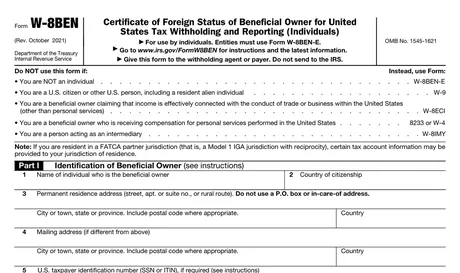
Form W-8BEN: How to Fill It In Line by Line (2026 Guide for French Residents)
Form W-8BEN shows a US payer you are not a US person and lets you claim a treaty rate. Who files it, each line with an example, rates, validity and W-8BEN-E.
Read the guide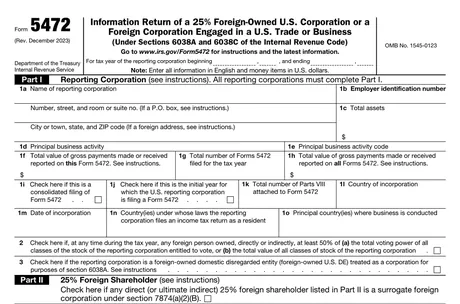
Foreign-Owned US LLC Taxes: What You Must File Each Year (2026 Overview)
You own a US LLC from abroad. The yearly filings in one page: Form 5472 and pro forma 1120 for the LLC, Form 1040-NR for you in some cases, state reports, W-8 forms, and what no longer applies. With deadlines and links to each guide.
Read the guideThis article is general information about US tax rules for foreign-owned LLCs, not advice for your specific situation. Rules change; check the date above and ask before you file.