What Is a Nonresident Alien? Meaning for US Tax, the Two Tests and What You File
What a nonresident alien is for US tax purposes, the green card test and the substantial presence test, the closer connection exception, what a nonresident is taxed on, and what it means for the foreign owner of a US LLC.
 Written by Amel Ouchene, IRS PTIN holderLast updated Not legal or tax advice10 min read
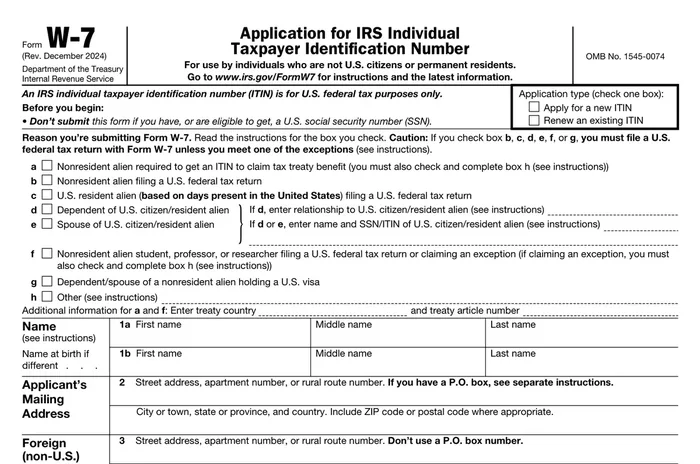
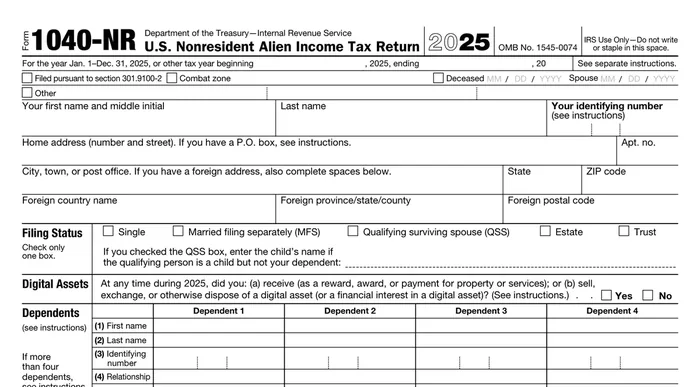
A nonresident alien is a person who is not a US citizen and who meets neither of the two residency tests of US tax law: the green card test and the substantial presence test. The status decides how the United States taxes you. Residents are taxed on their worldwide income; nonresidents only on US-source income and on income connected with a US business. This guide explains both tests, the exceptions, and what the status means if you own a US LLC from abroad. The residency rules come from IRS Publication 519, US Tax Guide for Aliens (2025 edition); the form rules come from each form's IRS instructions, listed under Sources.
In short:
- Definition: IRS Publication 519 says "If you are an alien (not a U.S. citizen), you are considered a nonresident alien unless you meet one of the two tests […]".
- Green card test: you are a resident if you were a lawful permanent resident at any time during the year.
- Substantial presence test: at least 31 days in the US this year, and 183 days over three years counting all days this year, 1/3 of last year's and 1/6 of the year before.
- What is taxed: income connected with a US trade or business at the normal graduated rates; other US-source income at a flat 30% or a lower treaty rate.
- Forms: the personal return is Form 1040-NR when one is due; to a payer you give a Form W-8BEN, not a W-9.
Nonresident alien: the meaning in one sentence
"Alien" in US tax law simply means a person who is not a US citizen. An alien is either a resident alien or a nonresident alien. You are a resident alien for a calendar year if you meet the green card test or the substantial presence test for that year. If you meet neither, you are a nonresident alien. Your visa type, your nationality and the state where your company was formed do not decide the question by themselves.
Owning a US company does not make you a US resident. A French or Swiss owner of a Wyoming LLC who lives and works at home stays a nonresident alien, as long as the days spent in the United States stay below the substantial presence test.
The green card test
You are a resident for tax purposes if you are a lawful permanent resident of the United States at any time during the calendar year. You generally have that status if US Citizenship and Immigration Services issued you a Form I-551, the green card. The status continues until it is taken away or is determined to have been abandoned.
The substantial presence test
You meet the substantial presence test for a year if you were physically present in the United States on at least:
- 31 days during the current year, and
- 183 days during the three-year period made of the current year and the two years before, counting all the days of the current year, 1/3 of the days of the previous year and 1/6 of the days of the year before that.
| Days in the US | Current year | Previous year | Year before | Weighted total | Resident? |
|---|---|---|---|---|---|
| 120 each year (IRS example) | 120 | 40 (1/3 of 120) | 20 (1/6 of 120) | 180 | No |
| 100 each year | 100 | 33.3 | 16.7 | 150 | No |
| 150, 120, 120 | 150 | 40 | 20 | 210 | Yes, unless an exception applies |
Any part of a day in the United States counts as a day, with exceptions. The United States here means the 50 states, the District of Columbia and US territorial waters, not US territories or US airspace. Our free substantial presence test calculator applies the formula to your own days.
Days that do not count
Publication 519 lists the days you leave out of the count:
- days you regularly commute to work in the US from a home in Canada or Mexico;
- days in transit, when you are in the US for less than 24 hours between two places outside the US (a business meeting at the airport ends the exception);
- days as a regular crew member of a foreign vessel;
- days you could not leave because of a medical condition that arose while you were in the US;
- days under a NATO visa as a member of a force or civilian component;
- days as an exempt individual.
"Exempt individual" does not mean exempt from tax. It means your days do not count. The four categories are foreign government-related individuals on an "A" or "G" visa (other than A-3 and G-5), teachers and trainees on a "J" or "Q" visa, students on an "F", "J", "M" or "Q" visa, and professional athletes in the US to compete in a charitable sports event. Teachers, trainees and students have time limits; for example, a student who has been exempt for any part of more than 5 calendar years generally starts counting days again. Teachers, trainees, students and professional athletes who exclude days, and people excluding days for a medical condition, file Form 8843 with the IRS.
The closer connection exception (Form 8840)
Even if you meet the substantial presence test, you can be treated as a nonresident alien if you:
- were present in the United States for less than 183 days during the year,
- kept a tax home in a foreign country during the year, and
- had a closer connection to that country than to the United States.
Your tax home is the general area of your main place of business or work, or, if you have none, where you regularly live. The exception is not available if you applied, or took other steps during the year, to become a permanent resident, or had an application for adjustment of status pending. You claim it with Form 8840, attached to your return or, if you have no return to file, sent to the IRS on its own by the due date of Form 1040-NR.
A tax treaty can also settle a dual residence through its tie-breaker rule. Whether that applies to you depends on your country's treaty and your situation; Melya does not give advice on the tax rules of your country of residence.
Dual-status year
The year you arrive or leave, you can be a resident for part of the year and a nonresident for the rest. Publication 519 calls this a dual-status tax year. Each part follows its own rules, and the return carries a statement for the other part. If you are in this case, read chapter 6 of Publication 519 before filing.
What a nonresident alien is taxed on
Publication 519 divides a nonresident alien's taxable US income into two categories:
- Income effectively connected with a US trade or business. After allowable deductions, it is taxed at the same graduated rates as US citizens and residents.
- Other US-source income, such as US dividends. It is taxed at "a flat 30% (or lower treaty) rate", usually withheld by the payer.
Income from sources outside the United States is generally not taxed by the US for a nonresident. Capital gains not connected with a US business are tax exempt if you were in the United States for less than 183 days during the year, with exceptions listed in Publication 519.
Which return: Form 1040-NR
A nonresident alien files Form 1040-NR, not Form 1040, when a return is due. You generally must file if you were engaged in a US trade or business during the year, or if tax due on other US-source income was not fully withheld. You may also file to get back tax that was over-withheld. If you received no wages subject to US withholding, the due date is June 15 for a calendar year. Our guide Form 1040-NR for a foreign LLC owner explains who is in which case.
Publication 519 adds a rule that matters for business owners: to claim deductions, a nonresident must file a timely return, and a return is generally treated as timely if filed within 16 months of its due date. If you are unsure whether your activity is a US trade or business, Publication 519 allows a protective return to keep your deductions.
Which form you give a payer: W-8BEN, not W-9
Banks, platforms and US clients often send a Form W-9 by default. A W-9 is for US persons, and signing it certifies under penalties of perjury that you are one. A nonresident alien individual gives a Form W-8BEN instead. It is not sent to the IRS; you give it to the payer who asks for it. Our W-8BEN guide goes through it line by line.
What it means if you own a US LLC from abroad
A single-member LLC owned by one person is, by default, disregarded for US income tax: its income is the owner's income. For a nonresident owner, three consequences follow.
- Payer forms. Form W-9 says that if the owner of a disregarded entity is a foreign person, "the owner must complete an appropriate Form W-8 instead of a Form W-9. This is the case even if the foreign person has a U.S. TIN." The owner's name goes on line 1 of the W-8BEN; the LLC's name can go on line 7, the reference number.
- Personal return. If you run the LLC entirely from abroad, with no US office, employees or dependent agents, you may not be engaged in a US trade or business, and may have no Form 1040-NR to file; this depends on the facts and circumstances.
- The LLC's own filing. A foreign-owned single-member LLC that had a reportable transaction with its foreign owner or another related party during the year, such as money put in or taken out, files Form 5472 with a pro forma Form 1120. It cannot be e-filed: it goes to the IRS by fax or mail. The penalty for not filing can be $25,000 per related party per year, with more added if the failure continues after IRS notice. See what a foreign-owned US LLC files each year.
Melya prepares the US filings of foreign owners of US LLCs and signs as paid preparer. Melya does not represent clients before the IRS. The Form 1040-NR assessment ($95) tells you in writing whether you owe a personal US return; preparation starts at $350 if you do.
Frequently asked questions
Does forming a US LLC make me a US tax resident?
No. Residency for an individual depends on the green card test and the substantial presence test. Owning a company, a US bank account or an EIN does not count.
What is the difference between a resident alien and a nonresident alien?
A resident alien meets the green card test or the substantial presence test and is taxed like a US citizen, on worldwide income. A nonresident alien meets neither and is taxed only on US-source income and income connected with a US business.
How many days can I spend in the US and stay a nonresident alien?
There is no single number. Under 31 days in a year you cannot meet the test for that year. Above that, the weighted three-year total must stay under 183 days. If you spend about 120 days every year, the IRS example gives 180, just under the limit.
Do I need an ITIN as a nonresident alien?
Only if you need a US taxpayer number and cannot get a Social Security number, for example to file Form 1040-NR or to claim a treaty rate in some cases. See how to get an ITIN from abroad.
Can a nonresident alien file Form 1040?
Not as a nonresident. Form 1040 is for citizens and residents. Publication 519 describes elections that let some married nonresidents be treated as residents; they have consequences for worldwide income and should be weighed case by case.
Sources
- IRS, Publication 519 (2025), US Tax Guide for Aliens: definition, green card test, substantial presence test, exempt individuals, closer connection, dual status, taxation of nonresidents, 16-month rule.
- IRS, Instructions for Form 1040-NR: who must file and due dates.
- IRS, About Form 8840, Closer Connection Exception Statement for Aliens.
- IRS, About Form 8843, Statement for Exempt Individuals.
- IRS, Form W-9 (Rev. March 2024): foreign owner of a disregarded entity.
- IRS, Instructions for Form W-8BEN.
- IRS, Instructions for Form 5472: foreign-owned US disregarded entities.
Keep reading
1040-NR Foreign LLC Owner: Do You Need to File?
Wondering if you must file Form 1040-NR as a foreign LLC owner? Learn how ECI, US trade or business status, and tax treaties affect your return.
Read the guide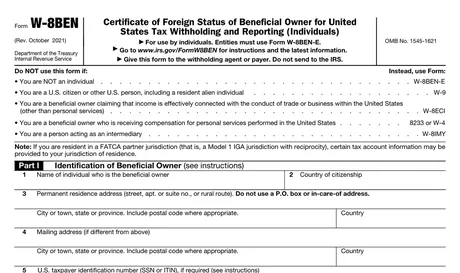
Form W-8BEN: How to Fill It In Line by Line (2026 Guide for French Residents)
Form W-8BEN shows a US payer you are not a US person and lets you claim a treaty rate. Who files it, each line with an example, rates, validity and W-8BEN-E.
Read the guide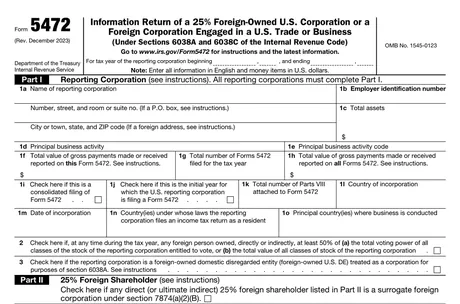
Foreign-Owned US LLC Taxes: What You Must File Each Year (2026 Overview)
You own a US LLC from abroad. The yearly filings in one page: Form 5472 and pro forma 1120 for the LLC, Form 1040-NR for you in some cases, state reports, W-8 forms, and what no longer applies. With deadlines and links to each guide.
Read the guideThis article is general information about US tax rules for foreign-owned LLCs, not advice for your specific situation. Rules change; check the date above and ask before you file.