Who Must File Form 5472? The Exceptions, the Zero-Activity LLC and the "De Minimis" Myth
Does your foreign-owned US LLC have to file Form 5472? The IRS test in plain words, the six exceptions and why only one can help a single-member LLC, why there is no minimum amount, and what counts as a reportable transaction.
 Amel Ouchene, US tax preparer (IRS PTIN holder). October 25, 2026, 5 min read
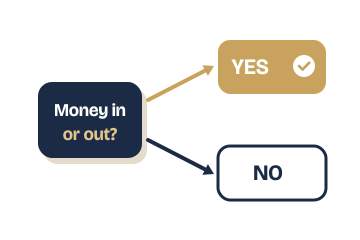
The question comes up every year: "My LLC made no money. Do I still have to file Form 5472?" The answer does not depend on revenue, profit or the size of the transactions. It depends on one thing: did your LLC have a reportable transaction with a related party during the year?
In short:
- A foreign-owned single-member US LLC is a "reporting corporation" for Form 5472, even though it is disregarded for income tax.
- It must file if it had a reportable transaction with a related party, and you, its owner, are a related party.
- Money you put into the LLC, or take out of it, is a reportable transaction. So is paying the LLC's costs from your own pocket in many cases.
- The instructions set no minimum amount below which the form is not required. A reporting shortcut exists for amounts of $50,000 or less, but it does not remove the duty to file.
- If nothing at all passed between you and the LLC, no Form 5472 is due for that year. This is exception 1 below.
Who is a "reporting corporation"
The Instructions for Form 5472 define a reporting corporation as either:
- a 25% foreign-owned U.S. corporation, which includes a foreign-owned U.S. disregarded entity (DE); or
- a foreign corporation engaged in a trade or business in the United States.
A foreign-owned U.S. DE is "a domestic DE that is wholly owned by a foreign person". For example, a US LLC whose only member is a nonresident individual, or any other foreign person such as a foreign company. For tax years beginning on or after January 1, 2017 (and ending on or after December 13, 2017), the IRS treats it as a corporation separate from its owner, for this reporting purpose only.
Who is a "related party"
For a single-member LLC, the main related party is you, the owner. The instructions call a related party any direct or indirect 25% foreign shareholder of the reporting corporation, and anyone related, within the meaning of sections 267(b) or 707(b)(1) or of section 482, to the reporting corporation or to such a shareholder. The glossary entry on related parties gives the full definition.
What is a "reportable transaction"
The instructions group reportable transactions in three parts of the form:
- Part IV: monetary transactions such as sales, purchases, rents, royalties, commissions, loans and interest.
- Part V: specific to foreign-owned U.S. DEs. The instructions say these include "amounts paid or received in connection with the formation, dissolution, acquisition, and disposition of the entity, including contributions to, and distributions from, the entity". In plain words: money you put in, money you take out, and costs linked to forming or closing the LLC.
- Part VI: transfers of property or services without money, or for less than full value.
The reportable transaction glossary entry gives examples.
The six exceptions, and which one can help you
The instructions list six cases in which a reporting corporation does not have to file. For a foreign-owned single-member LLC, they work out as follows:
| # | Exception | Can it help a foreign-owned US LLC? |
|---|---|---|
| 1 | The corporation had no reportable transactions of the types in Parts IV and VI and, for a foreign-owned U.S. DE, none of the type in Part V either | Yes, this is the one. If nothing happened, nothing is due |
| 2 | A US person who controls the foreign related corporation files Form 5471 | No. The instructions say this does not apply to foreign-owned U.S. DEs |
| 3 | The related corporation is a foreign sales corporation filing Form 1120-FSC | No. Same: does not apply to foreign-owned U.S. DEs |
| 4 | A foreign corporation with no permanent establishment under a tax treaty, which files Form 8833 | No. It concerns foreign corporations |
| 5 | A foreign corporation whose gross income is exempt under section 883 | No. It concerns foreign corporations |
| 6 | Both the corporation and the related party are not US persons and the transactions generate no US income or deductions | No. The instructions say exception 6 does not apply to foreign-owned U.S. DEs |
There is no minimum amount
Many owners hope that a small transaction escapes the rule. The instructions set no minimum amount below which Form 5472 is not required. A transfer of $50 from your bank account to the LLC's account is a contribution, so it is a Part V transaction. Two things can look like a threshold, and neither is one. First, Part IV lets you report an amount of $50,000 or less (in total, for a transaction or series of transactions with a foreign related party) as "$50,000 or less": that is a way of reporting, not an exemption from filing. Second, the phrase "de minimis" appears twice in the instructions: in the section on interest and royalty paid under hybrid arrangements (section 267A), and in a note on record-keeping rules for small corporations. Neither creates a filing threshold.
Common situations
- You opened the LLC and paid the state fee from your own account. That can be a Part V transaction. The line-by-line guide shows how to report it.
- The LLC earned money, but you never moved money between your account and its account. Revenue alone does not trigger the form. A reportable transaction with a related party does. Check who paid the LLC's expenses.
- The LLC is dormant. If truly nothing passed between you and it, exception 1 applies for that year.
- The LLC had more than one member for part of the year. The rules change. Ask before you decide.
What happens if you are not sure
Do not guess. The penalty is $25,000 for a reporting corporation that fails to file when due and in the manner prescribed, and a form that is substantially incomplete counts as not filed. A further $25,000 per related party applies for each 30-day period if the failure continues more than 90 days after the IRS notifies you. A short check of the year's bank activity is worth the time. Our free check asks the right questions, and the penalty calculator shows what a missed year can cost. If you already missed a year, read the catch-up guide.
Sources
- IRS, Instructions for Form 5472 (Rev. 12-2024): "Definitions", "Who Must File", "Exceptions from filing" and "Part V".
Keep reading
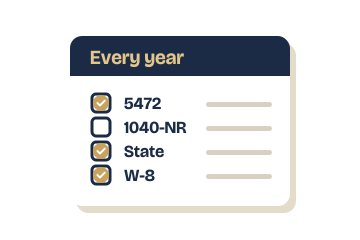
Foreign-Owned US LLC Taxes: What You Must File Each Year (2026 Overview)
You own a US LLC from abroad. The yearly filings in one page: Form 5472 and pro forma 1120 for the LLC, Form 1040-NR for you in some cases, state reports, W-8 forms, and what no longer applies. With deadlines and links to each guide.
Read the guide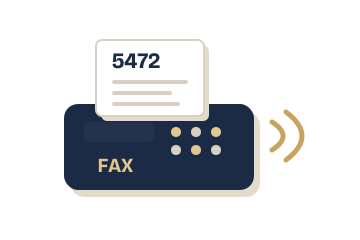
Form 5472: Fax Number, Mailing Address and Why You Cannot E-File It
Where to send the Form 5472 and pro forma Form 1120 of a foreign-owned single-member LLC: the IRS fax number, the dedicated Ogden mailing address, why e-filing is not allowed, how to send a Form 7004 extension, and what to keep as proof.
Read the guideThis article is general information about US tax rules for foreign-owned LLCs, not advice for your specific situation. Rules change; check the date above and ask before you file.